It's Now Or Never For The Bulls

In April of this year, I wrote an article discussing the 10 reasons the bull market had ended.

“The backdrop of the market currently is vastly different than it was during the ‘taper tantrum’ in 2015-2016, or during the corrections following the end of QE1 and QE2. In those previous cases, the Federal Reserve was directly injecting liquidity and managing expectations of long-term accommodative support. Valuations had been through a fairly significant reversion, and expectations had been extinguished. None of that support exists currently.”

It mostly fell on “deaf ears” as the market rallied back to highs. But the “worries” of the market have continued to mount despite the speculative rally. As Barbara Kollmeyer penned yesterday morning:

“The markets have enough to worry about these days, right? With major U.S. indexes in or near bear territory, a government shutdown underway and the White House falling over itself to assure us no one is firing Fed Chief Powell, Treasury Secretary Steven Mnuchin gobsmacked market participants by revealing that he made a weekend call from a beach in Mexico to the country’s six biggest banks, presumably to assure Wall Street that there’s ample liquidity sloshing around in the financial system.”

I can only presume the phone call between President Trump and Steve Mnuchin went something like this:

Trump: Hey, Steve. This market is bad. I mean it’s really bad… really bad. You need to do something to make it go up. I mean really go up.

Mnuchin: No problem. I’ll just call my buddies and tell them they need to start buying. You know, we can always hit up the “Plunge Protection Team” if we need too.

Trump: The what? Oh yeah… I’ve heard of those guys. Yeah, you do that. We need this market to go up really big. I mean really big. I got a whole big pile of s*** going on here, my ratings are down, and I need the market to go up. I mean go up a lot. You make that happen, okay. Cuz that a**hole Powell ain’t helpin’ me one bit.

Mnuchin: Check… I’m on it.

Of course, the only real reason that you would call the 6 major banks, and meet with the “Plunge Protection Team,” would be in the event there was a real concern about the financial stability of the markets. It didn’t take long for the markets to figure out there may be a real liquidity problem brewing out there (aka Deutsche Bank) and as Mark Decambre penned Monday afternoon:

“The S&P 500 index fell by 2.7% Monday, marking the first session before Christmas that the broad-market benchmark has booked a loss of 1% or greater – ever.”

That’s the bad news.

My Christmas Wish

If we take a look back at the markets over the last 20 years, we find that our weekly composite technical gauge has only reached this level of an oversold condition only a few times during the time frame studied. Such oversold conditions have always resulted in at least a corrective bounce even within the context of a larger mean-reverting process.
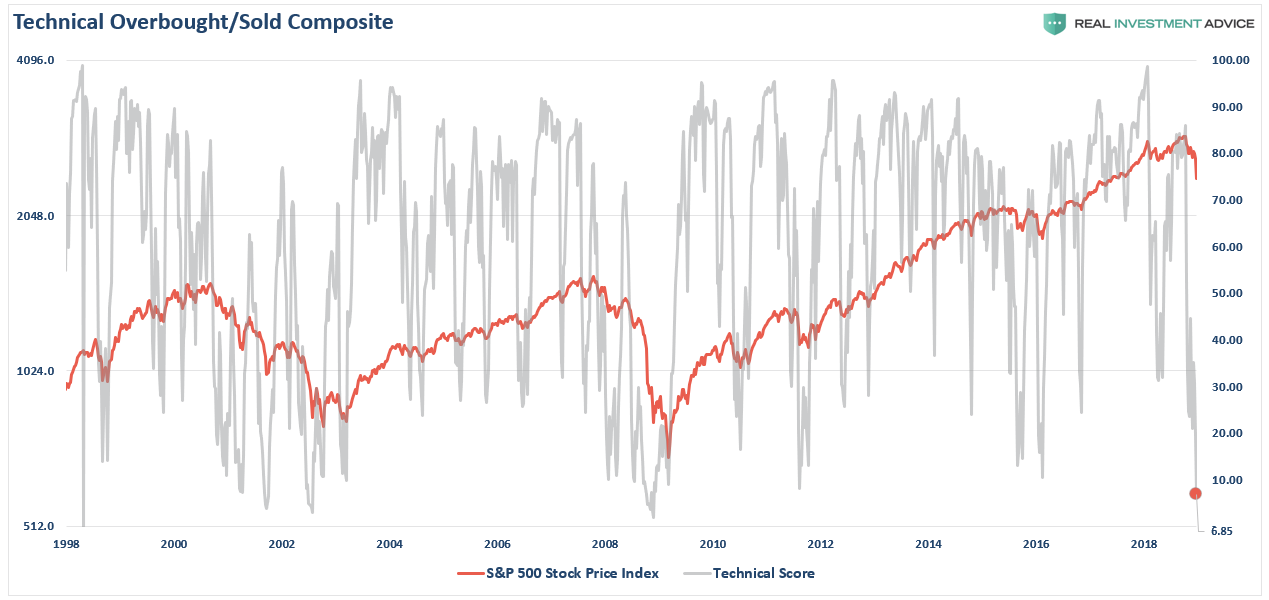
What this oversold condition implies is that “selling” may have temporarily exhausted itself. Like a raging fire, at some point the “fuel” is consumed and it burns itself out. In the market, it is much the same.

You have always heard that “for every buyer, there is a seller.”

While this is a true statement, it is incomplete.

The real issue is that while there is indeed a “buyer for every seller,” the question is “at what price?”

In bull markets, prices rise until “buyers” are unwilling to pay a higher price for assets. Likewise, in a bear market, prices will decline until “sellers” are no longer willing to sell at a lower price. It is always a question of price, otherwise, the market would be a flat line.

Again, what the weekly composite indicator suggests is that “sellers” have likely exhausted themselves to the point that “buyers” are likely starting to outnumber “sellers” to the point that prices will rise, at least temporarily.

This also highlights the importance of long-term moving averages. Again, as noted above, given that prices rise and fall due to participant demand, long-term moving averages provide a good picture of where demand is likely to be found. When prices deviate too far above, or below, those long-term averages, prices have a history of reverting back to, or beyond, that mean.

Currently, the market has started a mean reversion process back to the 200-week (4-year) moving average. As you will notice, with only a couple of exceptions, the 200-week moving average has acted as a long-term support line for the market. When the market has previously confirmed a break below the long-term average, more protracted mean-reverting events were already in process.
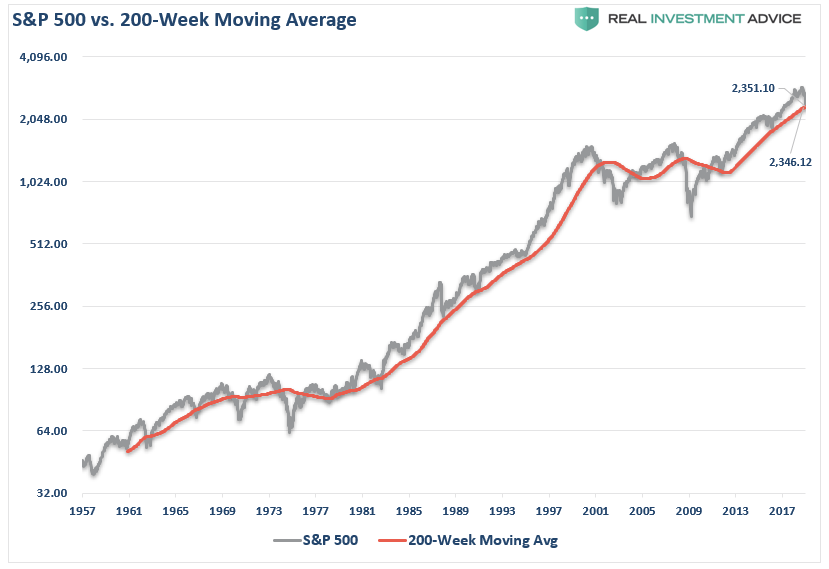
Currently, the bulls remain in charge for the moment with the market sitting just a few points above the long-term average. A weekly close below 2,346 on the S&P 500 would suggest a deeper decline is in process.

The same goes for the 60-month (5-year) moving average. With the market currently sitting just above the long-term trend support line, the “bull market” remains intact for now.
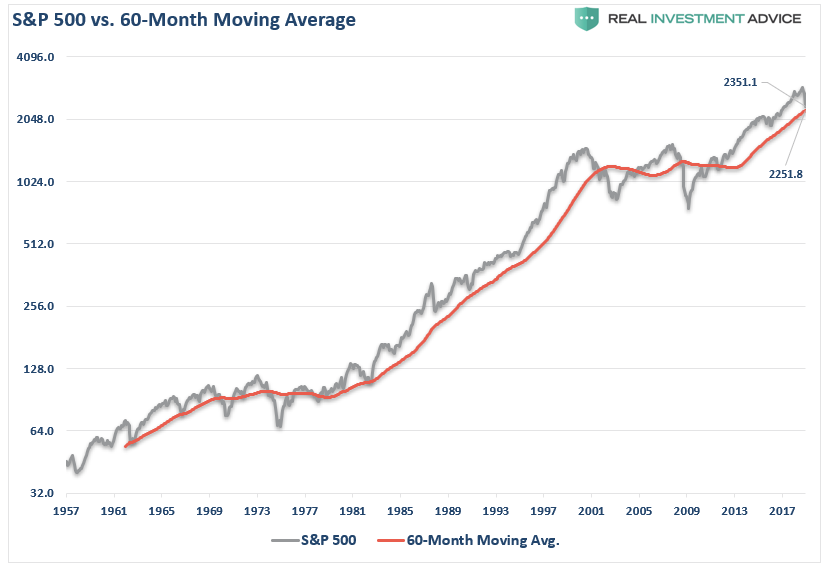
Again, a monthly close below 2,251 would suggest a more protracted “bear” market is underway.

How Much Of A Bounce Are We Talking About

Looking at a chart of weekly closes, the most likely oversold retracement rally would push stocks back toward the previous 2018 closing lows of 2,620-2,650.
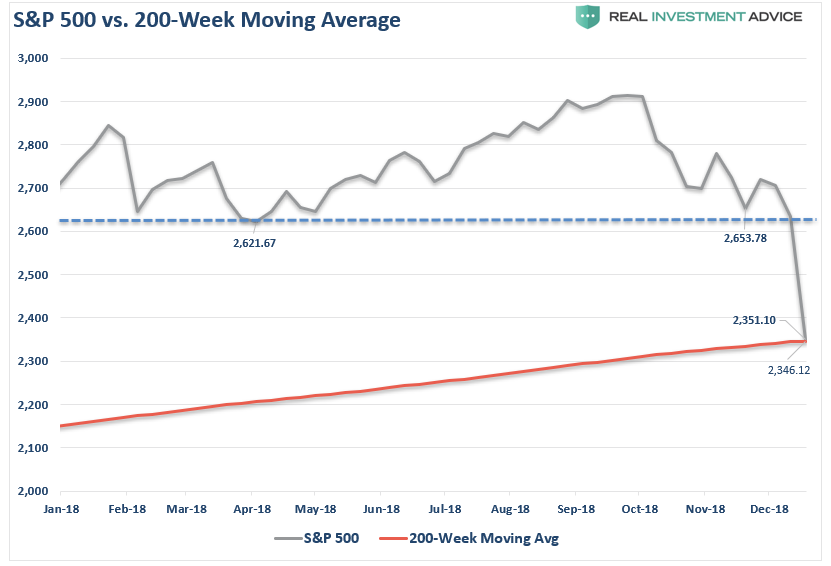
On a monthly closing basis, however, that rally could extend as high as 2,700.
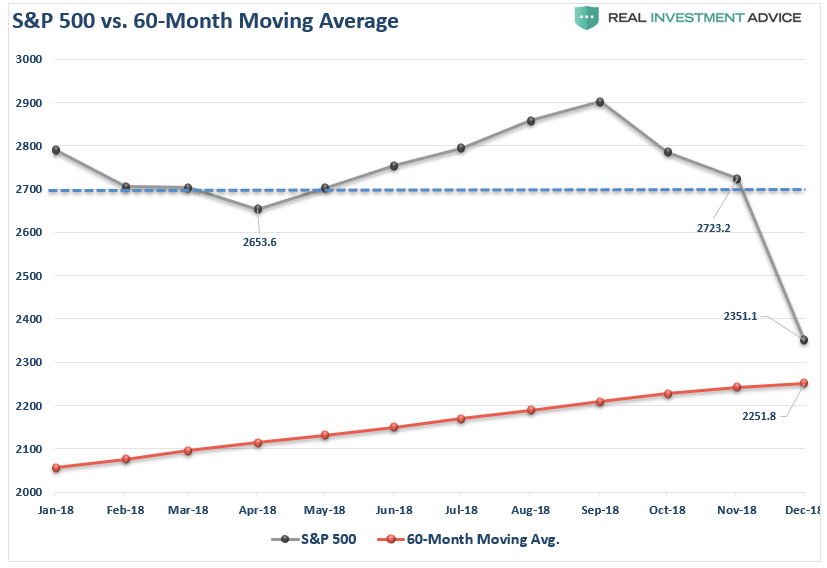
From yesterday’s closing levels, that is a 12.7% to 14.8% rally.

A rally of this magnitude will get the mainstream media very convinced the “bear market” is now over.

It likely won’t be.

The one thing about long-term trending bull markets is that they cover up investment mistakes. Overpaying for value, taking on too much risk, leverage, etc., are all things that investors inherently know will have negative outcomes. However, during a bull market, those mistakes are “forgiven” as prices inherently rise. The longer they rise, the more mistakes that investors tend to make as they become assured they are “smarter than the market.”

Eventually, a bear market reveals those mistakes in the most brutal of fashions.

It is often said the religion is found in “foxholes.” It is also found in bear markets where investors begin to “pray” for relief.

Very likely, there are many investors who have learned of the mistakes they have made over the past several years. Therefore, any rally in the market over the next few weeks to a couple of months will likely be met with selling as investors look for an exit.

Here is the other problem, there is currently no supportive backdrop for stocks on the horizon:

  • Earnings estimates for 2019 are still way too elevated.
  • Stock market targets for 2019 are also too high.
  • The Federal Reserve is still targeting higher rates and continued balance sheet reductions.
  • Trade wars are set to continue
  • The effect of the tax cut legislation will disappear and year-over-year comparisons revert back to normalized growth rates.
  • Economic growth is set to slow markedly next year.
  • Chinese economic growth will likely weaken further
  • European growth, already weak, will likely struggle as well.
  • Valuations remain expensive
  • The collapse in oil prices will weigh on inflation targets and economic activity (CapEx)

You get the idea.

There are a lot of things that have to go “right” to get the “bull market” back on track. But there is a whole lot more which is currently going wrong.

As I wrote in “The Exit Problem” last December:

“My job is to participate in the markets while keeping a measured approach to capital preservation. Since it is considered ‘bearish’ to point out the potential ‘risks’ which could lead to rapid capital destruction; then I guess you can call me a ‘bear.’

Just make sure you understand I am still in ‘theater,’ I am just moving much closer to the ‘exit.'”

After having sold a big chunk of our equity holdings throughout the year, and having been a steady buyer of bonds (despite consistent calls for higher rates), my “Christmas Wish” is for one last oversold rally to “sell” into.

The most likely outcome for 2019 is higher volatility, lower returns, and a still greatly under-appreciated risk to capital.

But, for the bulls, it’s now or never to make a final stand.

Just remember, getting back to even is not the same as growing wealth.

Hate Telemarketers? This Brilliantly Simple Legal Trick Totally Destroys Most of Them (Why Did It Take So Long?)

My fellow Americans, we live in a divided time. But there is one thing we all agree on.

It’s only getting worse. By next month, nearly half of all incoming cell-phone calls will be spam. Half! Sure, the government cracks down on a few of the worst offenders. But they’re fighting with a hand tied behind their back. Now, a small group of lawmakers wants to change that.

So here’s the problem, the reason why it hasn’t been fixed before — and why a laughably simple legal trick could very likely be the solution.

Surprise: it’s totally legal!

The scenario has to do with spoofed Caller ID. You’re at home, or at work, or wherever, and you’re suddenly interrupted by a call you don’t recognize. Only… it’s from the same area code and exchange as your cell phone. 

As an example, my phone number is (424) 245-5687. I might get a call from say, (424) 245-9999.

Now, the call isn’t really originating from that number — or likely from any real traceable number. It’s just set up that way to make it look like a local call, so I might be more likely to answer.

You might assume that doing this would be illegal. I mean, I’m a lawyer (not practicing, but still), and I was pretty sure people had been prosecuted for wire fraud for doing less.

But it turns out that’s not the case at all. In fact, the Federal Communications Commission says it’s only illegal to make this kind of spoofed Caller ID call if you do so “with the intent to defraud, cause harm or wrongly obtain anything of value.”

No provable bad faith or fraud? No problem, under the current law.

Welcome to Kentucky

It’s in this context that an unlikely savior might come to the rescue.

Meet Kevin Bratcher, a state legislator in Kentucky who introduced a bill to make it illegal to spoof a Caller ID for almost any reason at all.

It wouldn’t matter if you could later prove that, for example, “technically if the person jumped through all these hoops and paid these upfront fees they could get a free trip to the Bahamas.” 

Simply “causing misleading information to be transmitted to users of caller identification technologies, or to otherwise misrepresent the origin of the telephone solicitation,” would result in a very significant fine: $500 for a first offense, and $3,000 for each subsequent offense.

There would be  few minor exceptions for things: things like if the recipient knew his or her true phone number or location, or friends playing an innocuous prank on one another.

But beyond that, it would be a strict law.

“I came up with this because I just had a campaign, and everywhere I went people were asking me, ‘Why can’t you do something about all these calls with fake IDs?'” Bratcher, a Republican who has been in office for 22 years, told me recently. “And I was receiving them too. Just a light bulb went off on my head: Why is anyone trying to give you a call with a fake ID? That needs to stop.:

A big part of the problem

I realized something after Bratcher and I talked: it’s not just the scammers who have latched onto this spoofing strategy. 

For example, Bratcher didn’told me about receiving spoofed Caller ID phone calls from a 501(c)(3) he supports, and that’s based in Washington, D.C. The calls looked like they were coming from Kentucky.

That’s also what he says to those who might suggest that anyone sophisticated enough to spoof a Caller ID might also be sophisticated enough not to get caught. For a big part of these calls — maybe even a majority — the fraud stops with the spoofed number.

Legitimate charities aren’t going to want to be tarred with this brush.

Why can’t the government work for us?

For now, if the law were only changed like this in one state, it would be a complicated and potentially expensive strategy for legitimate charities to risk fines and bad press for spoofing IDs in Kentucky.

But while the initial news coverage of Bratcher’s bill suggested it might be the first attempt like this in the country, I’ve talked with Indiana officials who say they’ve been doing something similar.

It’s hard to believe that other states and the federal government itself would be far behind.

I’ve written a lot recently about other ways to cut down on telemarketing calls. There’s the “Lenny” bot, which is truthfully one of my favorites from an entertainment standpoint, as it’s simply an Australian chatbot designed to waste telemarketers’ time.

And since Lenny hasn’t actually been widely released, I also suggested perhaps we could all team up to do a sort of “manual Lenny” — basically stringing telemarketers along, wasting their time, and driving up their employers’ costs so as to destroy their business model.

Those stories got a giant response. Because it’s a problem everyone faces.

And so, shouldn’t our government work for us, instead of us having to hack together ideas on our own to solve these kinds of problems?

It feels like a winner issue for any lawmaker who wants to run to the head of the crowd, and become known as a champion of the people. People seem to want this.  

Ready, headset, go: Retailers racing ahead with VR for staff training

The circa 5,000 virtual reality (VR) videos viewed over two weeks by Costa Coffee staff, looking to understand how best to prepare the company’s Christmas drinks range, highlight the appetite for learning in the organisation using this technology.

That is the view of Laura Chapman, head of learning at Costa, who says festive-themed training videos were not mandatory for its workforce, but they really captured the imagination of its people at this busy time of year.

“It’s still early days for us, but feedback show us teams are motivated to learn this way,” she says, commenting on the recent introduction to over 1,500 Costa stores of Google Cardboard headsets and associated tools, enabling teams to access 360-degree footage of coffee-making tips and techniques.

The move was announced at the end of October, and was primarily a way of helping induct new staff in the ways and methods of Costa baristas ahead of the busy Christmas trading period. However, it’s a platform that can be used for training all year round.

Chapman says the VR element is embedded into what she describes as an already comprehensive training programme, and currently includes tips on how to make an Americano or the Black Forest Hot Chocolate which appears on the menu in December.

And as consumers continue to seek out more compelling experiences, expertise and different types of engagement during a trip to a retail or food and beverage outlet, there are several ways the Costa VR staff training tool is catering for these demands by preparing staff accordingly.

“We have a high volume of millennials in the workforce, so we wanted to be able to provide an engaging and innovative way of training them, one which would really excite them to learn,” says Chapman.

“The VR 360 videos we currently have provide a wider insight into the coffee growing process with footage of coffee plantations in Peru along with sneak peaks inside our state of the art roastery and coffee lab in Basildon.

“In addition to this, we also feature drinks tutorials on our key products, so teams can learn faster by immersing themselves in a real-life environment.”

Walmart is another big retail business that is well under way with its use of VR for operational gain. Facebook-owned Oculus Go VR headsets are being used by the grocer’s staff across the US, with the STRIVR-created content teaching people about technology and compliance, and aiding soft skill development like empathy and customer service.

To indicate the scale of the technology’s usage, the plan is for four VR headsets in every Walmart “supercenter”, and two units to every neighbourhood market and discount store. In total, the retailer says 17,000+ headsets are in use at Walmart today.

VR training must run deep

Ed Greig, chief disruptor at Deloitte, agrees that some of the best cases of VR usage in retail are around staff training.

“If you want to change the behaviour of your staff, that’s something you can do with VR in a way you couldn’t do with text-based e-learning,” he says.

“Some organisations are still using paper-based learning, and these are organisations that in other areas are very technical, but VR can enhance this process.”

Greig backs VR’s ability to improve the soft skills of store associates to align them with company values or to provide a platform for helping more senior staff improve management and empathy, but ultimately he sees the biggest gains for retailers coming from its wider deployment by human resources departments.

Wider recruitment

He acknowledges the idea of VR being used as a staff training tool has opened up conversations with Deloitte clients about their wider recruitment and subsequent learning strategy. As retailers embark on widescale digital transformation, he sees VR playing a central role in improving store design, supply chain operations, and general processes.

“Our motto is ‘fall in love with the problem not the solution’,” says Greig.

“There is a real danger with a new tech like VR and the subsequent modifications to that tech that people can fall in love with the solution [and forget why they need it in their businesses]. If you’re going to use VR, it should be about reshaping your entire learning strategy and how you look to develop people throughout the organisation.”

“It’s really effective when it’s used as part of the recruitment process, providing a consistency of experience for employees right from the first moment they have contact with a certain company,” he says.

“If retailers can nail that, it gives them a whole load of additional time where they’ve got people thinking about their brand values, and they can hit the ground running once they’re on the team.”

In a future internet of things (IoT) environment, Greig predicts multiple ways VR could play a part in the “digital twin” process, where a retailer’s physical premises are effectively digitally cloned. One can imagine staff using VR in this format to remotely change a retail store’s lighting or signage setting in real time, he asserts.

VR as standalone entertainment

VR is cropping up in various guises across retail, be it Virgin Holidays using Google Cardboard in stores to help customers experience locations before they book them, or Tommy Hilfiger kitting out global flagships with WeMakeVR-loaded SamsungGear devices to showcase its catwalk shows to in-store visitors.

But some of the most impactful uses of it revolve around creating an event out of VR technology. At Westfield Stratford City in 2016, Samsung ran an in-shopping-centre pop-up, enabling around a quarter of a million people to try out its Gear VR to experience roller coaster rides in North America or holidays in remote destinations.

Judging by that success, it is perhaps clear why ImmotionVR, a company that designs content for VR and operates simulators in public places around the UK, is continuing to scale its business based on a similar cinematic-like premise.

With 12 locations across the country, including at Manchester’s Arndale Centre, Birmingham’s Star City, Intu Derby, and most recently, Wembley’s London Designer Outlet, the company is creating theme-park-like, family-friendly experiences starting from £5 in shopping centres around the UK.

Martin Higginson, CEO of Immotion Group, says his company is looking to help the wider retail industry not by selling it VR technology as an internal solution, but by setting up its simulators and VR installations deep within retail – in the aisles of shopping centres or in locations left behind by collapsed or down-sizing retail chains.

“We’re focused on delivering an out-of-home experience,” he says.

“Currently shopping in general needs to bring theatre, because without that retail will wither on the vine. The high street and shopping malls need to change and start creating more theatre be it additional dining spaces, VR or something else; there needs to be a unique mix that creates a ‘theme park’ within shopping centres.”

Incentivising shopping mall visits

Higginson argues that venues from ImmotionVR, which creates its own content from its Manchester studios and offers VR experiences covering scenarios ranging from roller coaster rides to swimming with sharks off the coast of Tonga, can give families an added incentive to visit a shopping mall.

There is also a focus within the business on providing VR-enabled destinations for work parties and educational trips for schoolchildren.

“We want to create Disneyland in Westfield or Lakeside, or wherever – shopping centre owners have massive challenges with the likes of House of Fraser and Debenhams going through turmoil,” he says.

“We can bring experiences to shopping centres and fill them with guests throughout the week, helping malls become leisure destinations rather than venues for straight-out shopping.”

Higginson also argues the continued growth of his brand will open up VR to the mainstream. As a result, the tech might become more widely used in the home and in the workplace. In short, society could be about to see more of it in its various forms.

Costa and Walmart are clearly on the start of their VR journeys, but the staff engagement it has resulted in, and – in the case of Walmart – the rapid extended roll-out of the technology to date, suggests further exploration and usage is imminent.

VR roll-out a reality

Walmart announced in September that its VR technology was set to be accessible for all employee training across its entire US store portfolio, following initial usage solely for staff development in Walmart Academies. More than one million Walmart associates will now receive the same level of training as those in the academies, the retailer said.

Meanwhile, all of Costa’s fully owned stores – as opposed to its franchise and concession partners – have a Google Cardboard headset that allows staff to experience VR. And Chapman acknowledges the business is looking to make them available to its partnerships and international stores, while additional ideas for its usage keep arising.

“We could provide ‘on-the-job’ experiences to potential candidates so they get an idea as to what it’s like working in one of our stores,” she says.

“The coffee growing process and following the coffee journey from bean to cup is also something that we feel would be useful for inductions for everyone in the Costa family both among our store teams and in our support centre.”

Why SMS Marketing Could Be Your Brand's Secret Weapon in 2019

While still an essential marketing channel for brands of all kinds, it’s no secret that email marketing has become a much tougher nut to crack since its inception. With open rates dipping below 25 percent across the board, spam filters becoming more sophisticated and privacy laws continuing to pile on, alternatives to email marketing are looking more enticing than ever before.

Additionally, with social media channels like Facebook continuing on the path of slashing organic reach and becoming a “pay to play” platform, the time to explore new marketing opportunities is now.

One promising opportunity that’s often overlooked is SMS marketing, or text message marketing. Here are the reasons why SMS marketing could be the medium that takes your brand to new heights in 2019, how to get started and some best practices to ensure you’re using the channel most effectively.

People are always connected to their phones.

We live in a mobile-first world where people of all ages are increasingly becoming glued to their smartphones. In fact, it’s been recorded that, on average, people check their phones a whopping 80 times per day. As a result, it’s no wonder why open rates for SMS marketing typically hover around 82 percent. This makes sending texts to customers and members of your brand’s community the closest thing to being absolutely certain your content won’t get overlooked.

Additionally, unless the medium becomes saturated with every brand on the planet, it’s unlikely this trend will change anytime soon given how mobile-centric contemporary culture has become. 

Lastly, when taking a look at how often people change their social media profiles, email addresses and more, phone numbers are certainly updated the least. This essentially guarantees your SMS marketing will have longevity, something that can’t always be said about alternative marketing channels.

Here are some tips for getting started and making the most of your SMS marketing:

1. Get the right software. 

There are loads of mobile marketing platforms out there, but two of the best – based both on how long they’ve been in business, reviews and quality of their features – are Textedly and Avochato. Take some time to browse through other options though to see which product best fits your organization’s particular needs.

2. Begin collecting user’s phone numbers.

The next step is to begin collecting customer’s phone numbers. In the same way you try to snag the email addresses of website visitors and prospects, you need to begin collecting phone numbers as well. You can get started by inserting a field in all your company’s opt-in forms that asks for a prospect’s phone number. 

You can also run social media ads on Facebook, Twitter and beyond which asks viewers to opt-in through mobile for a discount, for entry into a contest or something similar. Lastly, you can also beef up your phone number list by giving away free content, such as a webinar or ebook, in exchange for their contact information. This tactic has proven fruitful for collecting email addresses, and the same can be done for phone numbers.

3. Make 100 percent sure you have the user’s permission to text them. 

Be absolutely sure you have a person’s explicit permission to use their phone number for promotional purposes. Not only is it the right thing to do from an ethical perspective, it’ll also make sure you’re not breaking the law. On top of that, be sure all your text messages used for marketing purposes have an unsubscribe option. 

4. Don’t bug your audience. 

Don’t exploit access to a person’s phone number. Be mindful of how personal and private a text message is, and act accordingly. Only send text messages when absolutely necessary. If you spam your list with a massive amount of messages, they’ll quickly get annoyed, unsubscribe and lose trust in your brand as a whole.

5. Know the limits of text messaging.

Let me be clear here. SMS marketing should, by no means, be a replacement to your email marketing. Instead, think of it as a supplement to your email efforts.

There are a couple limits of SMS marketing to keep in mind. For one, you have to keep your character count to a minimum, so maintaining your brand voice or telling a compelling story is difficult. Also, you can’t alert your audience as frequently as you can on social media for the reasons listed above.

If you’re looking for fresh ways to market your business in 2019, SMS marketing could be the secret sauce you’ve been looking for. Because of the exclusive nature of texting, stellar open rates and longevity of a person’s phone number, the future of SMS marketing looks bright. Be sure to give it a try in 2019. Best of luck.

Treasury Secretary Mnuchin Raises Questions of Bank Stability: Hold Onto Your Hat

The entire financial system that everyone, including all businesses, depends on sits on the need for trust. And in a couple eof tweets, the Treasury Department and Treasury Secretary Steven Mnuchin may have shaken that trust loose.

The Treasury Department said that Mnuchin held a series of calls with CEOs of major banks: Bank of America, Citi, Goldman Sachs, JP Morgan Chase, Morgan Stanley, and Wells Fargo.

The CEOs confirmed that they have ample liquidity available for lending to consumer, business markets, and all other market operations. He also confirmed that they have not experienced any clearance or margin issues and that the markets continue to function properly.

Equity markets have been rocky for various reasons, including tariff wars, general uncertainty, and the Fed increasing interest rates. No markets rise forever and we’ve seen a long run. A recent survey of global CEOs showed that chief financial officers overwhelmingly expect a recession by 2010 and many think 2019 will be the year.

In turbulent times, there are tremendous reasons for businesses to be wary and for governments to be concerned about basic banking issues like liquidity. Without enough money available, institutions can’t lend money and an economy can grind to a halt.

But aside from public inquiries like bank stress tests mandated by law, deep inquiries happen out of public views. No one wants to start a panic, undermine public confidence, and potentially start runs on banks, with people looking in total to take out more money than the banks actually have. (The lending business depends on institutions leveraging deposits, which means lending out many times more than they have on hand.)

Mnuchin’s move might have made sense if there were public concerns about bank stability. Bank stocks have been taking a hit with market oscillations. When people worry about the economy, they expect that banks may suffer. When things slow, fewer people and companies take out the loans that are the source of institutional income.

But there hasn’t been a lot of concern about underlying bank stability. At least, there wasn’t until Sunday evening when the tweets hit the fan. Particularly as Mnuchin was reportedly on vacation in Mexico.

While apparently intended to as a pre-emptive reassurance to investors, the tweet may have done just the opposite, stoking fears that the government is bracing for the worst.

MarketWatch then copied a number of investor tweets. Here’s one.

The substance was much of what I heard in my circle of financial people and business and economics reporters. One could only manage “WTF?”

It may be that all is well. But markets react to expectation and emotion and things have been shaken already. You now much reexamine your strategy in the wake of decreasing confidence in the economy and keep a close eye on new statements that could further shake things up.

After What President Trump and Congress Did on the Friday Before Christmas, the Government Is (Partially) Shutting Down. Here's What That Really Means

Less than two weeks ago, President Trump warned he’d shut down the U.S. Government if he didn’t get $5 billion for his border wall with Mexico in the new budget.

Democrats called his bluff; Trump didn’t blink. And so, a partial shutdown began at midnight.

So, what does it mean in practical terms to have a partial shutdown, which Trump himself predicted could go on for a “very long time?”

1.    About 75 percent of the government stays open.

Let’s start with the fact that it’s just a “partial” shutdown. There are some agencies that will be hit much harder than others, but most of the truly essential functions of government will continue.

Among these, the Department of Defense, the Department of Veterans Affairs, and the Department of Health and Human Services are already funded through 2019, so they shouldn’t be affected.

2.    But about 38 percent of employees will be hit.

There are 2.1 million federal employees. Of them, about 400,000 will be sent home without pay, and another 400,000 will be required to come to work, but won’t be paid.

Some of the affected departments here include Homeland Security, Justice, State, Transportation, and Treasury. As an example, all 60,000 employees of the Customs and Border Protection would be required to go to work without pay. 

This also includes Transportation Security Administration officials — so airports should remain open and more or less unaffected. It also includes the Border Patrol — ironic, since Border Patrol officers will have to work without pay, in a dispute over funding a border wall.

Also, “air-traffic controllers, prison guards, weather-service forecasters and food-safety inspectors, and would continue coming to work. Federal Bureau of Investigation agents, Forest Service firefighters” have to work, according to the Journal.

3.    The National Parks stay open

This is interesting — in earlier shutdowns, the spectacle of National Parks closing became big symbols of government ineptitude in a shutdown. But this time, the Parks Service is keeping most of its facilities open, even as about 80 percent of its employees will be furloughed.

On the National Mall for example, you’ll still be able to tour the monuments, but there won’t be Park Rangers available to offer information and assistance. The Smithsonian museums will remain open, too– at least through Jan. 1.

4.    It’s a good time to cheat on your taxes.

That’s because nine out of 10 IRS employees will be furloughed, so far fewer audits and return exams. That also means less chance of being able to call the IRS to ask for help on a tax issue.

5.    The Mueller investigation continues.

About 85 percent of Justice Department employees still have to go to work, even if they don’t get paid. The special counsel investigating possible collusion with Russia in the 2016 election however, will continue apace. That office’s funding is guaranteed.

6.    You can get your passport (probably) and the mail will still be delivered.

The Postal Service basically continues unaffected too, “because the Postal Service funds its operations through its own sales rather than tax dollars.”

7.    We sort of get a four-day repreive.

The shutdown began at midnight on Saturday December 22, which also happens to be the first of a four-day weekend for the government, since next Tuesday is Christmas.

All of which means that many of the 800,000 employees who won’t be paid, weren’t planning to work anyway the next four days. (In most past shutdowns, they ultimately got back pay when the government reopened.)

So, next Wednesday is that day when people will really start to notice — and then, if it lasts long enough, into the day after New Year’s Day.

8.    Weirdly, many workers have to come in, only to be told to go home.

Acording to the Post: Some will have to — briefly, anyway.

“This is what’s known as an “orderly shutdown,” during which employees who are furloughed can be allowed up to come in for up to four hours to preserve their work, finish timecards or turn in their government-issued phones. … What can we tell you? The federal government is a quirky enterprise.”

9.    Meat will be okay

At the Agriculture Department, the government will still inspect meat and other food. And support programs like food stamps will keep going.

10.    Sandwiches will be free. 

This is mostly for Washington DC area employees anyway, but if they’re affected by the shutdown, celebrity chef Jose Andres says his restaurants will offer free lunch sandwiches

You Should Definitely Work Over the Holiday Break

I’ve written about this previously but in brief but it’s that time of the year, so I’ll emphasize the point: if you have and office job and you’re given a choice and don’t have family commitments, it’s a smart move to work over the holiday break.

Now, you probably think I’m about to spout one of those rah-rah posts about how you’ll be getting more done than your coworkers, you’ll get a head start on the New Year, you’ll impress your boss by your commitment, and so forth. 

Screw that stuff.

IMHO, you should work over the holiday break because going into the typical office between Christmas and New Year‘s is like going on vacation… without getting charged for (and wasting) any of your real vacation days.

The typical office is pretty much empty during the holiday break. Nobody expects to get any work done because there aren’t enough coworkers to hold a meaningful meeting. Plus your customers figure you’re off, so they’re not going to bother you.

What happens over the holiday break is that people come in at around 10am, hang around, drink coffee, shoot the bull, flirt, goof off, play computer games, and so forth until about 2 or 3pm, and then go home.

I once worked in an office where the culture was so dysfunctional that calling it a “snake pit” would be an insult to serpents. During the holiday break, though, that office was downright pleasant. Everyone was relaxed and in a good mood.

When January 2nd came around it was a real shock and not a pleasant one when everything returned to its usual hellishness. But even then, because I “worked” over the holiday break, I had five extra vacation days to escape later in the year.

Even better, I could tell my boss and the coworkers who were out that I was so committed to the job that I worked over the holidays so that I could get a running start on the new year. It was hard to deliver that line with a straight face but somehow I managed.

Of course, I had to summon up the courage to actually TAKE those vacation days, since there was significant pressure to not to take vacations (it was seen as a lack of team commitment), but I’ve always been pretty impervious to peer pressure.

I’ve also worked in environments that weren’t that negative and even then, working over the holiday break was a good idea. Because while the snake pit was fun over the holiday break, the non-snake pit was an absolute riot. Every coffee (at least the ones I drank) were distinctly Irish.

As somebody who’s freelanced for the past two decades, the only things that I really miss about working a regular office job were the paid vacations and working over the holiday break. Heck, if I could, I’d drive back to the ol’ snake pit and hang out, even today.

China watchdog flags video game approvals; Tencent shares jump

FILE PHOTO: A Tencent sign is seen during the fourth World Internet Conference in Wuzhen, Zhejiang province, China, Dec. 4, 2017. REUTERS/Aly Song

SHANGHAI/BEIJING (Reuters) – Tencent Holdings Ltd’s shares jumped by as much as 4.2 percent on Friday after a regulatory official said that some new games have been cleared for sale after a lengthy freeze in approvals.

Feng Shixin, a senior official of the ruling Communist Party’s Propaganda department, said in a speech at a gaming conference in Haikou on Friday that a first batch of approvals for games had been completed, according a transcript of the speech and the organisers of the event.

China, the world’s biggest gaming market, stopped approving new titles from March amid a regulatory overhaul triggered by growing criticism of video games for being violent and leading to myopia as well as addiction among young users.

The freeze on new approvals has pressured gaming-related stocks and clouded the outlook for mobile games, rattling industry leader Tencent and smaller peers.

“We hope through new system design and strong implementation we could guide game companies to better present mainstream values, strengthen a cultural sense of duty and mission, and better satisfy the public need for a better life,” Feng said.

Earlier this month, state media reported that Chinese regulators set up an online video games ethics committee, raising hopes the government was preparing to resume an approval process that has been frozen for most of this year.

“This is clearly exciting news for China’s gaming industry,” a Tencent spokesman said in written comments.

“We’re confident that after the publishing license approval, we will provide more compliant, high-quality cultural works to society and the public.”

The gaming freeze in China has dragged down Tencent’s shares this year and wiped billions of dollars of its market value. The Hong Kong-listed firm’s stock is down around 23 percent this year.

Reporting by Adam Jourdan and Brenda Goh in SHANGHAI and Pei Li in BEIJING; Editing by Himani Sarkar and Christopher Cushing

This St. Louis Startup Believes Crickets Might be the Food of the Future

Want the bad news?

Despite dramatic increases in agricultural productivity, the world faces significant food shortages now and in the near future. Specifically, the United Nations Food and Agriculture Organization estimates that about 795 million people suffer from a chronic lack of nutritious food. And in order to prevent the widespread chaos that would come from mass hunger, agricultural productivity must increase by 60% by 2050 to meet the world’s food demands.

Unfortunately, that isn’t the only bad news.

Much of the developed world’s protein sources are produced in an unsustainable way. Recent research shows that while meat and dairy production is the source of just 18% of the calories and 37% of the protein the world consumes, those same agricultural products account for 83% of the world’s farmland–and loss of wild habitat to farmland is the single biggest reason for wildlife extinction.

It’s all very depressing.

Unless you’re willing to give eating crickets a try.

Seriously.

“Crickets are the world’s most sustainable protein,” said Sarah Schlafly, founder of St. Louis-based Mighty Cricket. “Cricket also has the highest quality protein out there, even higher than beef. It also has more iron than spinach, and as many Omega-3 fatty acids as salmon per 100 grams.”

Schlafly also notes that crickets are also a far more sustainable source of protein than beef.

“One pound of beef protein requires 1700 gallons of water. One pound of chicken protein requires 700 gallons of water. One pound of soy protein requires 5 gallons of water. One pound of cricket protein requires 1 gallon of water. We simply don’t have the resources to continue to support relying almost exclusively on beef, pork, and chicken in the West. By 2050 we will not be able to sustain the world’s current protein diet. Crickets and other edible insects are an important part of addressing those challenges.”

Yeah, but…they’re crickets.

The things that make my otherwise tough-as-nails daughter leap onto a chair and scream like she’s trying out for an ’80s horror remake.

Crickets can’t possibly taste very good, right?

Actually, they do.

Since food reviews aren’t normally a subject of my articles, I had to taste the product before writing about it.

My wife and I tried a pancake mix sold by Mighty Cricket, and while the consistency is a bit different than typical pancakes, the taste was excellent. Our kids didn’t notice a significant difference until after they were done eating and we told them we had just fed them pancakes made of crickets.

(Though the food was good, the big reveal was the best part of dinner. As a parent of a nineteen-year-old, thirteen-year-old, and ten-year-old, I can tell you that raising children can feel at times like being on the wrong end of an ISIS-style terror campaign inexplicably conducted by tiny people you love more than anything else in the world. So, you have to take the small wins–like secretly feeding them bugs.)

On a serious note, the earth is not getting any more land or water–but it is getting a whole lot more people. Helping American consumers become more comfortable with insect protein has become Schlafly and Mighty Cricket’s mission.

“We simply won’t be able to continue getting our protein exclusively from traditional sources,” said Schlafly. “Alternative proteins like crickets will be an important part of solving long-term food and resource challenges. Plus, cricket just tastes good.”

Good food that helps the environment and doubles as a fast and easy way to prank your kids?

Mighty Cricket sounds like a mighty good bet.

(That’s right. I’m closing out this article with a cricket pun, which research shows is roughly 2,000% better than a beef pun.)

The 1 Type of Job Candidate You're Almost Definitely Overlooking (and That's a Huge Mistake)

The U.S. unemployment rate is at a record low and is projected to continue decreasing in the coming years. That’s a big deal: There are more open roles than available talent to fill them, making the hiring market highly competitive for employers.

You’re probably looking for every hiring edge you can get, and your team might be overlooking a key candidate pool that is right in front of you — past candidates with whom you’ve interacted previously.

You probably chose not to move forward with them because they weren’t a fit for your team from a culture standpoint, or didn’t have the relevant background or experience to join your team. Maybe you couldn’t afford them, or maybe someone else was just better. That doesn’t always mean he or she will never be a fit for your team.

You always have the option to stay in touch and consider these candidates for open roles in the future–and the way the job market is going, you should seriously consider it. Here are two tips to build relationships with those quality candidates:

1. Share honest feedback.

Whether job seekers don’t make it past the initial application stage or don’t end up receiving an offer following a final interview — or anywhere in between — it’s critical to close the loop with job applicants. Recent data from the Society of Human Resources Professionals (SHRM) found that only 20 percent of candidates on average receive an email from a recruiter or hiring manager, and only 8 percent receive a phone call letting them know they aren’t moving forward in the hiring process.

That can be really frustrating. If their initial applications aren’t a fit for your open roles or team, an automated email letting candidates know you are moving in another direction works just fine.

But if candidates complete several steps of your hiring process — such as a prescreen surveys, skills tests and multiple interviews — it’s best to provide personalized, honest feedback. For example, a candidate who isn’t a fit for a given role for a handful of reasons can potentially join your team as a top employee several months down the road in a different role. Let candidates know how their skill sets and experience fit with other roles you foresee filling in in the future if this is the case.

2. Keep in touch.

This one’s easier said than done. Your team can’t hire every great candidate who applies to your open roles. But if you think they might be a fit for your team down the road, you should make an effort to stay in touch.

A simple way to keep in touch by connecting with top candidates on LinkedIn. Then, when new roles come up that past candidates are qualified for, you can easily scan through your LinkedIn network to jog your memory about some of your top candidates from the past.

You might come into contact with candidates you want on your team but don’t have the resources to hire them right away. For example, you might meet a great sales leader at a networking event but don’t have the budget for that particular role at the time.

Consider meeting with them informally every so often — either for lunch, coffee or something similar. Or, if you host job fairs or networking events at your business, invite top connections you have crossed paths with to show you’re still interested. Then, when you do have the perfect open roles for these candidates, they’ll remember all the effort you put into building the relationship, feel valued by your team and be more interested in applying.

Today’s stiff competition for top talent means employers need to think outside the box to attract and hire their best teams. By building relationships with previous candidates, you’ll have a leg up on other employers and fill open roles with quality employees sooner.

These 5 Productivity Hacks and Tools Can Save You a Bunch of Time in 2019

From reducing inefficiencies in often redundant and overlooked regular tasks to providing more advanced resources tailored to specific professions and businesses, productivity tools are increasingly prevalent. Conversely, simple methods for managing time more effectively and taking necessary breaks can alleviate stress and reduce instances of wasted time.

Time Boxing & Limiting Technology

Timeboxing has become an essential method for managing overloaded schedules, reducing stress, and increasing productivity. Timeboxing is predicated on the concept of managing tasks through interval time periods of topic-oriented work with small breaks interspersed between them.

 Similar to the Pomodoro Technique–which has been optimized and implemented in a variety of fields and applications–timeboxing aims explicitly to create a more consistent focus and mental clarity that mitigates fatigue. Stress is a byproduct of being overworked, which frequently stems directly from inefficient work and time management. Health concerns around stress are well-documented, and improving time management and productivity is not only good for your career but also your general health.  

Timeboxing takes some practice to develop into a habit and requires that you learn more about your attention and energy patterns. Dividing your time into intervals where you focus intensely on work for extended periods followed by shorter small breaks are designed to facilitate concentration. Our brains tend to work the most efficient through small intervals, and short breaks in between these intervals can provide a reprieve from stress and the feeling of work overload.

Limiting technology usage–mainly before bedtime–has also been touted as a practical way to improve efficiency in work, improve sleep, and increasing morning focus. Staring at screens at night or throughout the day can reduce energy and motivation the following morning. Overexposure to blue-screened device light can even throw off your circadian rhythm.

It’s exceptionally challenging to limit technology use in today’s world, especially considering the prevalence of screens everywhere, seemingly endless news feeds, and social media. However, reducing the use of technology–or at least monitoring it better with an app like Forest–can increase focus and even improve mood.

Tools and Tech

Digital tools for enhancing productivity are everywhere nowadays. Many of them provide automated task and project management while others offer more field-specific resources like software libraries. Regardless of how you’re looking to tackle time-saving and improved productivity, the variety of productivity technology and tools available today is seemingly endless.

Evaluating more general day-to-day time-saving tools, Vivid Technologies — led by founder and CEO Omer Khan — distinguishes itself as the company behind their Digital IVR product. The goal is to remove the frustrating customer service experience by transitioning the phone call into an interactive, user-friendly interface. Users can exchange voice, text, and picture messages with agents while concurrently working on other tasks. There is no waiting for a customer service rep to answer as the call service integrates directly with the user’s phone to alert them once an agent is available. Vivid developed out of a Google and Microsoft Accelerator and has now partnered with Telenor–one of the largest telecommunications companies in the world–to offer their products to all customers of Telenor.  Phone customer service is a largely outdated model, and Vivid caters to millennials with a more efficient and interactive approach.

Other platforms like ActiveCollab are comprehensive project management tools for working with clients and teams. The integrated payment and invoicing functionality bridges many of the challenges facing entrepreneurs, small businesses, and freelancers who have to jump back and forth between task management services and payment applications. Users can either select from a self-hosted application option on your own server or through their monthly cloud service plan. Communication tools, project management, and payment are primarily siloed technologies, incorporating them into one platform can ease learning curves for new tools and support business processes within one interface.

Another emerging collaborative tool is LucidChart, designed for working on diagrams and charts with other team members on any device. A diverse template gallery can be used for building diagrams on anything from financial portfolios to software development workflows. Businesses are trending to an increasingly visual medium, with the ability to confer their message easily projected through informative graphics and interactive guides to their products. LucidChart is available to anyone who needs to diagram rapidly and effectively.

The Productive Road Ahead

Increasing productivity to save time is one of the most effective ways to reduce work overload and balance your schedule. Subsequent effects on improved health through reduced stress are profound. For businesses, specific productivity tools and platforms can help reduce inefficiencies by heightening collaboration and providing the fundamental resources to build new products and designs. In a professional world moving faster than ever, sometimes it is vital to slow down and take measure of how to subtly improve productivity and save precious time.  

How to Keep Your Business Self-Sustaining After That Initial Success

In this age of constant market evolution and new technology, there is no such thing as a static business that is self-sustaining. The traditional approach of implementing stable and repeatable processes, so that your business can run itself, no longer works.

Just ask former big brand companies, like Blockbuster, Kodak, Lehman Brothers, and Sears, what happened to them.

As a small business advisor, I always recommend that being “self-sustaining” requires taking frequent and aggressive measures to step out ahead of the pack, including yourself, before you start feeling the pain of change and new competitors around you.

Specific measures that go beyond the traditional linear thinking include the following:

1. Develop new products for your existing segment.

Rather than enhancing the offering you have, develop and offer new products that capitalize on the customers that you already know well.

Competitors tend to focus on price and other variations to existing offerings. Too many businesses only think of new products when in crisis mode.

For example, Facebook added WhatsApp as a cross-platform messaging and Voice over IP (VoIP) service to enhance the self-sustaining growth their social media platform before any downturn. WhatsApp alone now has a user base of over one and a half billion users.

2. Introduce disruptive technologies to this domain.

Rather than rely only on linear thinking, the best entrepreneurs are always looking to offer in parallel a more dramatic new alternative.

Since these usually require a large investment, and more time, including customer education, they need to be started while your current business is still healthy.

Apple did this with the introduction of the smartphone, which altered the value chain for computers, video, and software, which were already staples that they knew well. Richard Branson is doing it with Virgin Galactic space rides, without impacting his Virgin Airlines.

3. Populating new domains to sustain your market.

If your product is already unique, then new domains would include adding online to enhance store fronts, and alternatives for business to complement consumer offerings.

These allow you to get new growth without fighting existing competitors. Defining new domains is even more powerful.

Elon Musk is doing both of these, first by expanding his Tesla electric vehicle initiatives beyond cars, into self-driving taxis and trucks, and secondly by entering new domains of transportation with SpaceX and Hyperloop. He entertains no sense of a static business.

4. Redefine your product to reach a new category.

This strategy, often called breakaway positioning, has the intent of expanding your product opportunity into a previously unreachable category.

It also has the advantage over competitors of retaining existing customers, while at the same time attracting new customers from another category.

For example, Swatch was able through marketing to define their watches as fashion accessories, as well as timepieces, greatly expanding their segment. Uber added UberLUX, with stylish high-end cars, to declare access to the limousine category.

5. Implement a plan of regular strategic acquisitions.

Unlike a total reliance on internal innovation and organic growth, growth through acquisition or merger is generally faster and can be self-sustaining as a process. Further, acquisition offers other advantages such as easier financing, instant economies of scale, and new market penetration.

For example, even the giant Amazon acquired Whole Foods as a growth entryway into the competitive grocery and food industry. Apple acquired Shazam to quickly boost Apple Music by letting users identify songs, movies, and commercials from short audio clips.

The reality is that you can never stop changing your business, and still be self-sustaining. The strategies outlined here may seem intuitively obvious, but they require real effort and discipline to implement, perhaps why so few companies consistently outperform the market.

Change is the only constant in business, so now is the time for making your plan for regular change a priority.

The Best Sales App I've Seen in 15 Years and OMG It's Free

What makes a sales app great? Three things: 1) it helps you sell, 2) it’s easy to use, and 3) it costs nothing or next-to-nothing. Using that criteria, it’s obvious why CRM isn’t a great sales tool because while 1) it (arguably) helps you sell, it’s also 2) difficult to use, and 3) can cost you big time in lost opportunity cost, even if you’re using freeware.

Because of that, for the past 15 years, the most valuable sales tool has been LinkedIn. Sales is all about building relationships and that’s impossible without knowing who works inside a company and the role they play in the decision-making. Thus while LinkedIn was designed originally for recruiters, it’s been a total godsend for Sales and Marketing.

However, while LinkedIn has been the king of sales tools since it was launched in 2003, its own email system (InMail) has never caught on as an alternative to regular email. As one of my clients put it a couple of days ago: “I just don’t get many responses when I use it.” And that’s too bad because InMail is theoretically much better than regular email.

Email has become increasing important to sales and marketing because now that most people (especially decision-makers) no longer answer their phones making cold calling obsolete. Today, the only effective form of outbound sales is email marketing which everyone is doing (but most aren’t doing it very well.)

The big challenge with email marketing, however, has always been getting the decision-makers’ email addresses. While you can buy email lists on the open market, the data is often inaccurate or out-of-date. Also, email lists encourage one-to-many email marketing (aka SPAM), which isn’t all that effective.

What IS effective with email marketing is a well-researched personalized email that doesn’t attempt to sell but instead just makes contact and opens up a conversation. I’ve written extensively on how to execute this strategy and helped dozens of companies develop the technique. BTW, if you want to fix your cold emails so that you get geometrically more responses, I’m still available for an hour each week… at least for now.

Once you’ve identified a decision-maker on LinkedIn, the difficult part has always been getting that decision-maker’s real email address (business or, better yet, personal). In the past this involved a online research, guesswork, and even calling the reception desk and asking. None of these approaches were ideal and all consumed a fair amount of time.

Well, no longer, because there are now some very easy-to-use tools that troll through big data on the web and give you the email addresses and even the telephone numbers of the profiles that interest you. I’ve tested several of these tools and have concluded the best is Contact Out, which runs as a Chrome Extension.

Contact Out took me 5 seconds to install and 5 seconds to learn to use (it’s a one-click drop down). To test it, I looked up some of my former editors. Not only did I get their current work emails, I also got personal emails for most of them, and even work telephone numbers. If I’d tried this by hand, it would have taken hours of tedious effort.

Contact Out lets you harvest 50 profiles a day for free, but that’s far more than any salesperson needs if they’re doing personalized emails which, again, is the only form of email marketing that actually works.

I also tried two other Chrome Extensions, Lusha and Hunter, but they didn’t seem to harvest as much data. Hunter was interesting, though, because it got me email addresses associated with a specific website, even if the people in question didn’t have LinkedIn profiles. Since neither tool is expensive, you might want to add them to your tool box, too. 

Oracle sees strong third quarter on cloud strength, share rise

(Reuters) – Oracle Corp on Monday forecast current-quarter profit above estimates after growth in its cloud services and license support unit helped the business software maker surpass Wall Street expectations for the second quarter.

FILE PHOTO: People gather prior to the start of a keynote speech at the All Things Oracle OpenWorld Summit in San Francisco, California September 24, 2013. REUTERS/Jana Asenbrennerova/File Photo

Shares rose 5 percent, with the company saying that excluding fluctuations in exchange rates, it expected third-quarter adjusted profit to be between 86 cents and 88 cents per share.

Analysts on average were expecting 84 cents, according to IBES data from Refinitiv.

Revenue at its cloud services and license support unit, its biggest, rose 2.7 percent to $6.64 billion and beat analysts’ estimate, as more companies shifted to cloud computing from the traditional on-premise database model to cut costs.

Oracle’s in June created a new revenue reporting structure that merged its cloud and software license businesses, which analysts have said gives little insight into the standalone performance of its cloud unit.

Oracle is a late entrant to the rapidly growing cloud-based software business, but has aggressively stepped up its efforts to catch up with rivals such as Workday Inc, Microsoft Corp and Salesforce.com Inc.

“Oracle’s growth in cloud services and license support of just 3 percent appears to be contradicting the strength in the overall cloud market,” said Daniel Morgan, senior portfolio manager of Synovus Trust Co, which hold 152,500 shares in the company.

Last month, Workday reported a 35 percent jump in cloud subscription revenue, while Salesforce’s flagship product Sales Cloud grew 11 percent.

“Oracle is still dragging behind other old line enterprise software players like Microsoft in its transition to becoming a top cloud company,” said Morgan, whose firm also hold shares in Salesforce and Microsoft Corp.

The company’s net income rose to $2.33 billion, or 61 cents per share, in the second quarter ended Nov. 30. Excluding items, the company earned 80 cents per share, beating the average analyst estimate of 78 cents.

Total revenue fell marginally to $9.56 billion, but brushed past analyst expectation of $9.52 billion.

Shares of the company were up at $48 in after-market trading.

Reporting by Vibhuti Sharma in Bengaluru; Editing by Arun Koyyur

So Long, Step Count: My Brief and Sad Smartwatch Hiatus

The rash started out as a small cluster of bumps, angry little irritants arriving out of nowhere. Was it poison oak? Hadn’t I touched some gnarly stuff during a recent hike? It never spread beyond my wrist, and over time, the itchy patch went away. Then I put a smartwatch back on my wrist, and the rash reared its red, scaly head again.

Thus began my smartwatch hiatus, after years of wearing some type of Bluetooth-connected thing on my left wrist. I still don’t know what caused the inflammation, and it would be irresponsible to guess. At the time, I had been alternating between a Garmin watch, an Apple Watch, and some bracelets.

I’ve been somewhat addicted to tracking my activity, information that’s interesting to absolutely nobody except me. Entire events—runs, hikes, swims, attempts to surf, walks downtown—don’t feel as valid if they aren’t recorded on my wrist. Or, as my colleague Adrienne So once said, “If a tree falls without a pedometer, did it really happen?”

At the same time, the value of an activity tracker isn’t always proportionate to the burden of one. They all have these damn proprietary chargers, and you have to charge them all the time, and for what? So they can count steps? The more I thought about it, the more I needed a break from wearing a wrist Tamagotchi. Be gone, smartwatch, I thought.

Then I started to really miss it.

My relationship with wearables started in 2011. Back then, the Fitbit Ultra and Jawbone Up were all the rage, pedometers for the modern age thanks to the availability of motion-tracking sensors and Bluetooth chips. An editor assigned me a story about Jawbone, and I became obsessed with this new class of products.

Could these elastomer wrist dongles eventually do more than track steps and offer shoddy estimations of your sleep? Would people be compelled to wear them for longer than a few months before ditching them? Were these wearables even telling us the truth? (For a brief period in 2013, I made a spreadsheet to compare step counts from four different activity trackers, suspecting they all would spit out different numbers during the same one-mile walk. They did.)

When Apple’s long-rumored smartwatch launched in 2015, I flew to New York to retrieve a review unit, then immediately flew back to San Francisco with the not-yet-released product. During the flight I felt like the future was pulsing on my wrist. Sure, the watch hadn’t fit under the barcode scanner at the airport, even though it was supposed to now serve as my boarding pass. And maybe that future flashing on my wrist was just the same green cluster of optical sensors that were in other wrist wearables. But the Apple Watch felt different. It was validation from the world’s most valuable company that wearable technology was a thing.

At first, the Apple Watch didn’t do much to move the needle technologically. It was slow, its battery barely lasted longer than a day, and faltered as a platform for third-party apps. Other smartwatches had (and still have) their own drawbacks. Samsung’s watches run on limited Tizen software. LG’s Watch Sport was comically ill-fitting on my wrist when I tried it. And plenty of smartwatches have found their place firmly in the world of licensed fashion brands: Did you know you could buy a Android Wear-based, Michael Kors-branded rose gold smartwatch named “Bradshaw”? (I couldn’t help but wonder: Was the watch named after the TV character who couldn’t help but wonder?)

But then smartwatches got better. When Apple waterproofed the Apple Watch, it didn’t just seal up ports to keep the water out; it came up with a solution that involves a tiny vibrating component ejecting water from the smartwatch’s speaker. This still blows my mind, not only because I was able to wear my smartwatch in the pool but because it was so delightfully over-engineered. Samsung introduced smartwatches with rotating bezels, so you can either twist the edge of the watch to navigate it, or tap the touchscreen. Rotating bezels aren’t just satisfying to use; they’re a bridge between the old watch world, in which we twist and turn and crank things, and the new watch world, where we so effortlessly swipe.

Crucially, the software improved, too. Apple Watches invite you to “close the rings,” one of the most clever and addictive forms of personal gamification I’ve seen on a wearable. The newest Apple Watch has an ECG app now. Garmin’s smartwatch maps are so advanced that you can access topographic maps on your wrist. You can even stream music from a smartwatch these days. In a few years, smartwatches have gone from dorky wrist computers with middling features to actually useful devices.

It’s been a week and a half since I stopped wearing any kind of smartwatch on my wrist. This marks the first time in years I’ve packed a travel bag without a proprietary smartwatch charger in it, or walked and run and cycled without tracking my activity. I don’t know what my resting heart rate is right now. I’m telling myself this is OK.

Last week, a group of people asked why I like wearing a smartwatch. I started to say that it was for three reasons: fitness tracking, text message notifications, and… what was the third? I forgot the third reason, and I don’t think there is one.

Maybe I really don’t need a smartwatch. Neither do you. Some people might say they need their phones, and that’s understandable. But a smartwatch—even one that purports to give you unique insights into the inner workings of your heart? Not so much.

Still, I want mine back. Sometimes our relationships with our things don’t always make sense. We like some things because even if they require more care and attention than they ever return, you once received that important text message on your wrist at a moment when you really couldn’t look at your phone. We like them because sometime companies over-engineer a feature on a product, and you at least respect the effort. We like them because they’re attached to us, and as a result, we become attached to them.

Is it bizarre that a friend of mine used to adjust the time zone on his Apple Watch so he could gain three more hours in the day and “close the rings” at night? Maybe, but a Facebook addiction would likely make him feel much worse about himself than taking 80 more steps. Is it egocentric that I enjoy looking back at the Garmin maps of places I’ve been and hiked and ran, or that I want to see if my resting heart rate is lower than it was the day before? Sure, but maybe it’s better to creep on your own private info than it is to complete an activity just so you can share it on social.

My rash is almost gone, and I’ve already decided I’m going back to wearing a smartwatch. Maybe in the new year. Maybe my Garmin watch, since its battery lasts so long. Maybe I’ll swap in a different band, just in case.


More Great WIRED Stories

Confirmed! Those LIGO Gravitational Wave Signals Were Real

After the historic announcement in February 2016 hailing the discovery of gravitational waves, it didn’t take long for skeptics to emerge.

The detection of these feeble undulations in the fabric of space and time by the Laser Interferometer Gravitational-Wave Observatory (LIGO) was said to have opened a new ear on the cosmos. But the following year, a group of physicists at the Niels Bohr Institute in Copenhagen published a paper casting doubt on LIGO’s analysis. They focused their criticism on the experiment’s famous first signal, a squiggly line—representing the collision of giant black holes more than a billion light-years away—that was printed in newspapers worldwide and tattooed on bodies.

Quanta Magazine


author photo

About

Original story reprinted with permission from Quanta Magazine, an editorially independent publication of the Simons Foundation whose mission is to enhance public understanding of science by covering research developments and trends in mathematics and the physical and life sciences.

Even as LIGO sensed more gravitational-wave signals and its founders received Nobel Prizes, the Copenhagen researchers, led by professor emeritus Andrew Jackson, claimed to have found unexplained correlations in the “noise” picked up by LIGO’s twin detectors. The detectors — L-shaped instruments whose arms alternately stretch and squeeze when a gravitational wave passes — are located far apart in Livingston, Louisiana, and Hanford, Washington, to ensure that only gravitational ripples from space could wiggle both instruments in just the right way to produce the telltale signal. But according to Jackson and his team, the correlations in the noise data suggested that LIGO might have detected not gravitational waves but some terrestrial disturbance, perhaps an earthquake. They claimed that, at the very least, something was not right with the instruments or with the LIGO scientists’ analysis.

The findings were worrisome. LIGO scientists checked their work again, and a party of experts visited the Niels Bohr Institute last year to dig into the details of Jackson and colleagues’ algorithms. Two groups of researchers set out to independently analyze LIGO’s data and the Copenhagen group’s code.

Now both groups have completed their studies. The new papers explain different aspects of the problem that led Jackson and his coauthors to make their claim. Both analyses definitively conclude that the claim is wrong: There are no unexplained correlations in LIGO’s noise.

“We see no justification for lingering doubts about the discovery of gravitational waves,” the authors of one of the papers, the physicists Martin Green and John Moffat of the Perimeter Institute for Theoretical Physics, said in an email.

The pair has no direct ties to LIGO. “It’s important for science for people to do analysis of data and results independently of the group,” Moffat said, “especially for such a historic event in the history of physics.”

The LIGO gravitational-wave detectors in Hanford, Washington (here), and Livingston, Louisiana.

LIGO Lab/Caltech/MIT

LIGO Lab/Caltech/MIT

Frans Pretorius, a gravitational-wave expert at Princeton University who was not involved in any of the recent studies, said that for more than a year, he and most of the physics community have been satisfied that LIGO’s analysis, and its discovery, are sound. Nevertheless, he said, “it’s important that finally there is a thorough analysis in the form of a paper,” rather than “media back and forth.”

The spokesperson of the 1,200-person LIGO Scientific Collaboration, David Shoemaker of the Massachusetts Institute of Technology, said by email that the new findings corroborate internal discussions among the team. “Seeing those two non-Collaboration re-analyses does reaffirm my certainty that the detections [of gravitational waves] are genuine,” Shoemaker said, “and also is a reinforcement of our earlier perception of where the Jackson et al. paper has problems.”

In an email, Jackson called Green and Moffat’s paper, which was published in Physics Letters B in September, “absolute rubbish.” When asked to elaborate, he appeared to wrongly characterize their argument and didn’t address the most important issues they raised about his team’s work. Jackson also dismissed the second set of findings by Alex Nielsen of the Max Planck Institute for Gravitational Physics in Hannover, Germany, and three coauthors, whose paper appeared on the physics preprint site arxiv.org in November and is under review by the Journal of Cosmology and Astroparticle Physics. “We are in the process of writing a response to this latest paper,” Jackson wrote, so “I will not explain where they (once again) made their mistakes.”

“The Copenhagen group refuse to accept that they may be wrong,” Moffat said. “In fact, they are wrong.”

Experts say the problem came down to a combination of blunders: several by the Copenhagen physicists, and one by LIGO.

To help tease out the puny wiggle of a passing gravitational wave from a noisy background, LIGO’s algorithms constantly compare the lengths of the twin detectors’ arms, which oscillate when agitated by a passing gravitational wave or background noise, to “template waveforms” — possible gravitational-wave signals calculated from Einstein’s general theory of relativity. When there’s a close match between a signal detected in Hanford and one sensed shortly before or after in Livingston that also fits a template waveform, email alerts fly around the world.

The scientists then carefully determine the “best-fit” gravitational waveform that most closely matches the signal in the two detectors. When this waveform is subtracted from each of the signals, this leaves behind “noise residuals” — the remaining little wiggles in the detectors that should be uncorrelated, since the instruments are about 2,000 miles apart.

In their 2017 paper, the Copenhagen group claimed to have discovered that the noise in Livingston matched the noise in Hanford seven milliseconds later, just as the putative gravitational-wave signal arrived at both detectors. They interpreted this to mean that LIGO either hadn’t cleanly separated their signal from the noise, or correlations in the noise at exactly the right moment were responsible for the entire signal.

However, Green and Moffat identified a series of errors in the Copenhagen team’s data-handling that they say conspired to create a correlation that wasn’t really there.

To look for correlations in the residuals, Jackson and his colleagues picked a 20-millisecond segment of Livingston data and slid 20-millisecond segments of Hanford data across it, registering correlations whenever peaks overlapped with peaks and troughs with troughs. They found that strong correlations happened when the data was offset by seven milliseconds. But Green and Moffat noticed that when they took Jackson and colleagues’ code and reversed the procedure, fixing the Hanford noise data and sliding Livingston data segments across it, the correlation at seven-milliseconds offset went away. “This was a big red flag because it says, OK, you don’t have a calculational method that’s robust,” said Green, an expert in digital signal processing. Rather, the lengths of the data segments and their asymmetric treatment were “tuned to obtain a correlation signal at just about any desired time offset,” he said.

In a separate calculation, Jackson and his team seemed to find non-random, correlated patterns of peaks and troughs throughout the noise records in the two detectors. But Green and Moffat inferred that the Copenhagen physicists had not “windowed” the two sets of noise data. Windowing is a standard technique of smoothly dialing a signal to zero at the beginning and end of a segment of data before doing a mathematical operation called a “Fourier transform” that facilitates comparisons to other data. The Fourier transform treats a data segment as if it is cyclical, looping together the beginning and end. If the segment isn’t windowed, abrupt changes at the endpoints called “border distortions” can wind up looking like correlations when the data is compared with a second data set.

When Green and Moffat windowed the two sets of noise data, the claimed correlations went away. “Our concern is that the calculation that was done by the Copenhagen group was contrived to get the result they wanted to get,” Green said.

Nielsen and his coauthors — Alexander Nitz, Collin Capano and Duncan Brown — also concluded that the claimed correlation in the noise isn’t real, but they say the error can be attributed at least in part to LIGO’s mistake in providing the wrong data in the first figure of their 2016 discovery paper in Physical Review Letters.

Figure 1 is “the thing people have tattooed on their arms,” said Brown, a gravitational-wave astronomer at Syracuse University and a former LIGO member, who left the collaboration this year to pursue independent analyses of the data.

The figure’s top panel shows side-by-side squiggly lines representing the gravitational-wave signal detected in Livingston and Hanford. Below that are template waveforms closely matching the signals and, in the bottom panel, jagged lines representing the “noise residuals” in the two detectors, after the template waveform has been subtracted from each data set.

Brown explained that Jackson’s code, which he examined in detail during a visit to Copenhagen last year, detects an overlap in the residuals at seven milliseconds offset for a mundane reason: The template waveform shown in Figure 1 is not the “best-fit” waveform that LIGO actually used in its rigorous analysis. The figure was created for illustrative purposes, Brown and others explained. The figure-maker had matched a template waveform to the twin signals by eye, rather than using the best-fit signal as determined by careful calculations. Small imperfections in the subtracted waveform meant that there was some gravitational-wave signal left in both data sets that didn’t get subtracted off, and which ended up mixed in with the noise shown at the bottom of Figure 1—producing correlations that could be teased out by Jackson and colleagues’ algorithms. “What they discovered was an imperfect subtraction” of the signal waveform, Brown said. “When we subtract a better waveform than the one used in the PRL paper, we find no statistically significant residuals.”

“If LIGO did anything wrong,” he added, “it was not making it crystal-clear that pieces of that figure were illustrative and the detection claim is not based on that plot.” Jackson, however, accused LIGO scientists in an email of “misconduct” and making “the conscious decision not to inform the reader that they were violating one of the central canons of good scientific practice.”

Which is to blame, LIGO’s sloppy figure or the Copenhagen group’s faulty calculations? “In reality, I think it’s both,” Brown said. If Jackson and his colleagues were able to tune their parameters to create correlations at seven milliseconds offset, as Green and Moffat’s findings suggest, this would have essentially biased their calculations. Then, at the same offset, their biased algorithm picked out the imperfectly subtracted bits of signal in the noise, reinforcing the false impression.

Jackson, however, maintains that the unexplained correlations are present and says he and his colleagues are preparing a rebuttal to the recent work. He still thinks LIGO’s first, most powerful gravitational-wave signal (and all others by extension) might have been something else altogether — perhaps, he said, “a lightning strike in Burkina Faso, seismic, or even one of the mysterious ‘glitches’ that LIGO detectors see about once an hour.”

But both new papers reviewed and reanalyzed LIGO’s raw data and rediscovered the gravitational-wave signals within it, using different algorithms than LIGO’s. Other researchers have done the same.

“I think the pursuit of independent analyses of gravitational-wave data is a very important and valuable thing to do, and we are delighted that more people are getting involved,” said Shoemaker, LIGO’s spokesperson. “That the Jackson et al. work has stimulated some additional independent investigations can be seen as a positive outcome, but I personally think it comes with a fully unnecessary cost of ‘drama.’”

Visualizations of the 10 black hole collisions detected by LIGO so far, along with the gravitational-wave signals they produced.

Meanwhile, LIGO’s twin detectors, along with a third instrument in Europe called Virgo that switched on in 2017, have recorded 10 black hole collisions to date and one space-time wiggle from colliding neutron stars. Scientists announced the four latest black hole detections this month and released dazzling graphics showing the universe’s growing population of these mysterious, invisible, super-dense spheres. When the neutron-star collision was detected last year, 70 telescopes swiveled toward the fireworks; their observations indicated the cosmic origin of gold, the expansion rate of the universe and more.

Brown said it isn’t surprising that LIGO’s revolutionary discovery invited skepticism. A powerful event was detected “basically the day we turned it on,” he said, and the rate of black hole collisions in the cosmos has turned out to be at the high end of expectations.

“The universe loves gravitational-wave astronomers,” he said.

Original story reprinted with permission from Quanta Magazine, an editorially independent publication of the Simons Foundation whose mission is to enhance public understanding of science by covering research developments and trends in mathematics and the physical and life sciences.


More Great WIRED Stories

YouTube Posted a Video on the Official YouTube Channel. It Quickly Became the Most-Hated YouTube Video of All Time

This is a story about the most-hated YouTube video anybody ever posted to YouTube. In fact, it might just be the most-hated video anybody ever posted anywhere.

Even more embarrassing: it’s a video that YouTube itself posted to the official YouTube Spotlight channel. And people really don’t like it. (It’s embedded below.)

The irony is, this was was supposed to be a big, easy win for YouTube. It’s the YouTube Rewind 2018 video, which is intended to be a feel-good, end-of-year, wrap-up video about YouTube moments and personalities. YouTube has posted a version every year since 2010. It’s usually a fan favorite.

Only, not this year. This year, they blew it big time.

11 million dislikes and counting

After just over a week, the official YouTube Rewind 2018 video now has more “down votes” or “dislikes” than any other video in YouTube history. As of this writing, nearly 130 million people have watched it, and 11 million gave it a thumb’s down.

Compare that to just 2.2 million who clicked that they liked it.

We’ll get into why the video bombed so badly, along with a lesson or two for anyone trying to cultivate an audience. But first, let’s put those numbers in context.

Because until this week, the most-hated video of all time was the video for Justin Bieber’s “Baby,” which has 9.9 million dislikes.

It took eight long years for that many people to vote down “Baby,” and meanwhile the Bieber video also has 10 million likes, so it’s slightly net positive.

YouTube could only dream of hitting those kinds of numbers. 

It’s so bad! (How bad is it?)

Again, the video is below, so you can judge for yourself. I recommend you watch it in Chrome with video speed controller enabled and tuned to 180 percent or so. That’s what I did.

It was still interminable, although I admit I’m not exactly the demo they’re looking for. Anyway, it starts with Will Smith (fair enough), saying that for the 2018 video, he’d like to see lots of Fortnite and YouTube personality Marques Brownlee.

He gets his wish as it cuts to a Fortnite Battle Bus full of YouTubers–including Brownlee.

And from then it goes through a frantic, massive series of jump cuts and quick edits, moving from one YouTuber and scene to another, with almost no context or way to follow what’s going on.

Worse in the minds of many viewers, is that the video ignores many popular YouTube stars in favor of people who aren’t even really YouTubers–like Stephen Colbert, John Oliver and Trevor Noah, for example. And that really created some controversy.

‘A a chaotic barrage of clips’

Don’t just take my word for it, or the thousands of YouTube users who left negative comments, or the millions who down-voted it. Instead, for a fantastic explanation, I’d go to Brownlee, the YouTube personality whom Will Smith wanted to see.

Sure enough, he created a response video (despite the fact that he briefly stars in the original), where he explains the production process and agrees with millions of other people that, yes, it’s pretty horrible.

The problem, he thinks, is that the millions of YouTuber viewers who watched it were expecting what YouTube used to give them in its year-end Rewind videos: a collection of top moments starring the most popular creators.

But YouTube wants something different, as Brownlee puts it: a safe sizzle reel that it can demo for advertisers. So it can’t feature creators like say, PewDiePie, who has the most-subscribed channel on YouTube and sort of represents the site’s original organic creators–but who has also been tied to white supremacists

The result, as Brownlee puts it, is “a chaotic barrage of clips that’s just really hard to watch,” since YouTube wants to give the appearance of including tons and tons of video personalities–without including the ones like PewDiePie that will turn off big advertisers. But that only makes more obvious the omission of some big YouTube stars that YouTube isn’t particularily happy to have.

If YouTube wants to fix the video for next year, Brownlee suggests: “You’ve got to leave some stuff out. You can leave me out. I don’t mind.”

Here’s the infamous YouTube Rewind video–followed by Brownlee’s response. Let me know what you think in the comments.

[embedded content]

[embedded content]

California is Considering Taxing Texts. Here's the 1 Insane Detail Hardly Anyone Has Noticed

Absurdly Driven looks at the world of business with a skeptical eye and a firmly rooted tongue in cheek. 

It sounded bad. 

So bad, in fact, that it was just the sort of thing you’d expect from California.

My home state has a certain reputation —  especially among those who don’t live there — for taxing its inhabitants,

This week, there came news of a potential new tax, one that sounded so Californian as to border on parody.

And a million accusing Eastern fingers pointed toward the west and its serial predilection for socialized nonsense. (I’m not sure how many of those fingers came from East Coasters, how many from Russians and how many from Russians who had emigrated to the East Coast.)

The essence of the tax lies in the fact that people have stopped talking on the phone so much. 

Yes, California currently taxes phone calls. It dedicates the revenue raised to providing the least fortunate with some sort of telecommunications service.

It does the same with other utilities, too.

The phone call revenue has, naturally, fallen as telephonic talking has fallen, so the state proposes taxing texts. Doing this, says California’s Public Utilities Commission, could raise $44.5 million.

Which leaves one small, painful detail: Not many people send text messages.

You might think you do, because texting has become a generic term for constantly saying things in writing to people via your phone — only to occasionally be misunderstood.

Yet the majority of people use iMessage, WhatsApp or even Facebook Messages. These are sent over the internet. 

And, if California suddenly decided it now wants to include these over-the-web services in its tax proposals, does that mean it can start taxing every email? 

Now there’s a delicious revenue-generating idea that could instantly finance so many Californian projects and deter people from sending those dreary reply-all emails that plague business life. 

Naturally, phone industry lobbyists are drinking — I mean, working — late into the night to prevent California’s proposal from being instituted in a vote on January 10.

Should it pass, there might be enormous confusion, with users assuming that all their phone messaging is being taxed? 

What if they stopped texting altogether? 

That simply wouldn’t be the modern world anymore.

Self-Driving Cars? Don't Hold Your Breath

Yeah, yeah, I know. Self-driving cars are just around the corner. Any day now. They’re being tested everywhere. They’re going to revolutionize transportation. Put thousands of Uber drivers and teamsters out of work. Don’t hold your breath.
Despite conventional wisdom, AI programmers haven’t been able to solve basic problems, like identifying pedestrians, or differentiating between dogs and children. AI programmers have totally failed to implement programs that exhibit anything resembling common sense, which is exactly what’s needed to drive in a world full of humans.

According to a recent article on NPR, in California (the only state that requires the reporting of automobile deaths from autonomous vehicles) there have been three deaths in about 10 and 15 million miles of autonomous driving, That compares VERY unfavorably to conventional driving, where it would typically take 260 million miles to result in three deaths.

According to the Guardian, a whistleblower at Uber recently revealed that Uber’s self-driving program results in an accident every 15,000 miles. By comparison, the average human gets in 3 to 4 accidents over 65 years while driving an average of 13,474 miles a year, for roughly one accident every 250,000 miles. That’s a pretty big delta for a technology that’s supposedly right around the corner:

Self-driving cars are particularly hazardous to pedestrians, according to NPR, because their ability to recognize pedestrians somewhat more than 90 percent of the time. Humans, by contrast, are incredibly good at spotting other humans, with a success rate probably around 99.99 percent. Even AI proponents at Carnegie Mellon admit that a five year old child can out perform AI when it comes to common sense decisions. As NPR explains:

“[autonomous vehicles] can’t figure out what a pedestrian is or [what] a pedestrian is going to do. They can’t separate a child from a dog. Sometimes a tree branch overhanging the road will be taken as something in the way.”

Such limitations have huge consequences, as when an autonomous vehicle killed a pedestrian because it couldn’t perceive that she was walking a bicycle. Similarly, simply slapping some stickers on a stop sign–an action that wouldn’t fool a toddler–can confuse a self-driving car.

And that’s far, far beyond the capability of any AI program, because it literally requires human intelligence.

Thus, according to the Guardian, so-called “self-driving” cars will always need a human being present to “take the wheel” when the AI program fails. It should seem obvious, though, that any automobile that requires a human “minder” isn’t really self-driving; it’s just doing cruise control on steroids.

So, while cars will be able to parallel park on their own, and function reasonably well in environments, like freeways, where human behavior is well-delineated, it seems highly unlikely, despite all the rosy hype, that fully autonomous cars are in our near future. Barring the emergence of the “singularity” (which seems unlikely), self-driving cars will remain an oxymoron.

But, but… what about all the breakthroughs we’ve been seeing in AI?

Not ready for prime time, I’m afraid. While AI programmers have successfully improved their programs’ ability to play games with bounded, well defined rules, they’ve been stumped when comes to operating inside environments (like businesses) where the rules are flexible and unbounded.

This is not to say that AI–as currently implemented–can’t be useful. Facial recognition, for example, is good enough to be useful to law enforcement. AI programs can play games (which have bounded rules) much better than humans. AI is excellent at looking for patterns in huge data sets. But none of those functions require common sense, which is required for a fully autonomous vehicle.

I fully expect to get plenty of pushback on this column because I’ve been making similar observations about AI literally for decades and I always get exact same pushback. Every freakin’ time. I’ve come to the conclusion that arguing with AI true believers is like arguing with fundamentalists about the end of the world which )like the long-awaited “singularity”) never seems to actually arrive. 

Apple to push software update in China as Qualcomm case threatens sales ban

SHANGHAI/SAN FRANCISCO (Reuters) – Apple Inc, facing a court ban in China on some of its iPhone models over alleged infringement of Qualcomm Inc patents, said on Friday it will push software updates to users in a bid to resolve potential issues.

FILE PHOTO : An attendee uses a new iPhone X during a presentation for the media in Beijing, China October 31, 2017. REUTERS/Thomas Peter

Apple will carry out the software updates at the start of next week “to address any possible concern about our compliance with the order”, the firm said in a statement sent to Reuters.

Earlier this week, Qualcomm said a Chinese court had ordered a ban on sales of some older iPhone models for violating two of its patents, though intellectual property lawyers said the ban would likely take time to enforce.

“Based on the iPhone models we offer today in China, we believe we are in compliance,” Apple said.

“Early next week we will deliver a software update for iPhone users in China addressing the minor functionality of the two patents at issue in the case.”

The case, brought by Qualcomm, is part of a global patent dispute between the two U.S. companies that includes dozens of lawsuits. It creates uncertainty over Apple’s business in one of its biggest markets at a time when concerns over waning demand for new iPhones are battering its shares.

Qualcomm has said the Fuzhou Intermediate People’s Court in China found Apple infringed two patents held by the chipmaker and ordered an immediate ban on sales of older iPhone models, from the 6S through the X.

Apple has filed a request for reconsideration with the court, a copy of which Qualcomm shared with Reuters.

WHERE’S THE HARM?

Qualcomm and Apple disagree about whether the court order means iPhone sales must be halted.

The court’s preliminary injunction, which the chipmaker also shared with Reuters, orders an immediate block, though lawyers say Apple could take steps to stall the process.

All iPhone models were available for purchase on Apple’s China website on Friday.

Qualcomm, the biggest supplier of chips for mobile phones, filed its case against Apple in China in late 2017, saying the iPhone maker infringed patents on features related to resizing photographs and managing apps on a touch screen.

Apple argues the injunction should be lifted as continuing to sell iPhones does not constitute “irreparable harm” to Qualcomm, a key consideration for a preliminary injunction, the copy of its reconsideration request dated Dec. 10 shows.

“That’s one of the reasons why in a very complicated patent litigation case the judge would be reluctant to grant a preliminary injunction,” said Yiqiang Li, a patent lawyer at Faegre Baker Daniels.

HIT LOCAL SUPPLIERS

Apple’s reconsideration request also says any ban on iPhone sales would impact its Chinese suppliers and consumers as well as the tax revenue it pays to authorities.

The request adds the injunction could force Apple to settle with Qualcomm. But it was not clear whether this referred to the latest case or their broader legal dispute.

Qualcomm has paid a 300 million yuan ($43.54 million) bond to cover potential damages to Apple from a sales ban and Apple is willing to pay a “counter security” of double that to get the ban lifted, the copy of the reconsideration request shows.

Slideshow (4 Images)

Apple did not immediately respond to questions about the reconsideration request and Reuters was not independently able to confirm its authenticity.

Lawyer Li said the case would undoubtedly ramp up pressure on Apple, especially if a ban was enforced.

“I think that Qualcomm and Apple, they always have those IP litigations to try to force the other side to make concessions. They try to get their inch somewhere. That’s always the game.”

Reporting by Adam Jourdan in Shanghai and Stephen Nellis in San Francisco; Editing by Himani Sarkar

Tesla To 90,000: Delivery Forecasts For The Fourth Quarter

Tesla is on track to deliver more than 61,000 Model 3s in the fourth quarter.

Summary

Much is written about Tesla (TSLA) and Elon Musk on this platform and elsewhere. The circus that surrounds Tesla is well-known and heavily-covered on this platform – so I won’t write about any of that here.

Instead, this is simply an attempt to forecast Q4/18 vehicle deliveries based on the best available data. Overall, I estimate that Tesla will deliver ~91,085 vehicles – up 9% from last quarter, including over 61,000 Model 3s. This estimate implies that Tesla will meet their 2018 target for 100,000 Model S and X delivered with a bit of breathing room to spare.

Given analyst revenue estimates of ~3.5% sequential growth, Tesla will need to keep ASPs from slipping more than 4.5% to meet those top-line targets, assuming my estimates are close and assuming the Tesla’s non-automobile units are flat sequentially. Tesla has raised prices several times over the last few months, which should help prevent too much price erosion on their vehicles, although this will be offset by the introduction of the $46,000 Model 3 MR.

In my view, Tesla has a good chance of beating its Model S/X delivery target and a reasonable chance of beating analysts’ top-line estimates. I will continue to hold my Tesla shares.

Model S Delivery Estimate: 14,907 Vehicles

Each of the estimates herein is based primarily on three pieces of data.

Each estimate is based on Tesla’s actual delivery information from past quarters. This data is available in Tesla’s quarterly update letters delivered on earnings day. Tesla also provides estimates of this data in an 8-K filing within a day or two of the end of a quarter. This data provides Tesla’s actual deliveries but is only available quarterly – unlike many manufacturers which provide similar data every month.
This data provides Tesla

(Inside EVs Monthly Plug-in EV Sales Scorecard)

Estimates are also based on monthly estimates for Tesla’s American sales from Inside EVs Monthly Plug-in EV Sales Scorecard. Inside EVs only includes sales in the United States but is updated each month, usually within a few days of the end of the month.

This data is a bit incomplete for the most recent month, as shown above: Spanish Model S registration results are not yet available.

(Tesla Motors Club)

Estimates are further based on European vehicle registration date from Tesla Motors Club. A post on TMC’s forum contains European sales data from each European country, with data updated as it becomes available. This data is a bit incomplete for the most recent month, as shown above: Spanish Model S registration results are not yet available.

Compiling these three data sources into one for the Model S, and combining the data into quarters rather than months, I arrive at the following table:

Compiling these three data sources into one for the Model S, and combining the data into quarters rather than months, I arrive at the following table

(Author based on data from Inside EVs and Tesla Motors Club)

Here, the “Model S Registrations, Europe” is data from Tesla Motors Club, by quarter. “Model S Sales, United States” is data from Inside EVs, also organized by quarter. Total Model S Sales is simply the addition of those two lines and Tesla Deliveries refers to Tesla’s published total Model S deliveries in a given quarter. Most of this data comes from 8-Ks, as Tesla doesn’t usually break down S vs. X deliveries in its quarterly update letters.

As shown, over the past year, sales in Europe and the United States have made up ~85% of sales of Model S vehicles over the past year, with the remainder of sales primarily occurring in APAC and Canada.

We could simply multiply sales by ~1.5x to move from the two-month Q4/18 sales to three-month sales, but history tells us this would be very inaccurate. Why? Because Tesla tends to sell the fewest vehicles in the first month of each quarter and more vehicles in the last month of each quarter:

Tesla Monthly Sales for the Model S and X show monthly seasonality

(Author based on data from Inside EVs and Tesla Motors Club)

As shown, Tesla has had six months where they sold more than 10,000 Model S and X vehicles combined: 9/16, 12/16, 3/17, 9/17, 12/17, 3/18, and 9/18. All of those months are the third month of a fiscal quarter. Indeed, since the start of 2015, Tesla has always delivered the most vehicles in the third month of the quarter.

Thus, simply multiplying the first two-month results by 1.5x will yield inaccurate delivery estimates: Those estimates would have been too low in each of the past 15 quarters.

Tesla will sell nearly 15,000 Model S vehicles in Q418

(Author based on data from Inside EVs and Tesla Motors Club)

To remedy this problem, the above chart includes only the first two months of European registrations and Inside EVs sales estimates from every quarter. For example, last quarter, Insides EVs showed Tesla having Model S sales of 1,200 in July, 2,625 in August, and 3,750 in September. Thus, the above chart shows 3,825 (1,200 + 2,625) Model S vehicles sold in the United States in Q3/18 – excluding the 3,750 reported September sales.

The Tesla deliveries above are actual deliveries for the quarter, and the percentage of sales is sales in the first two months divided by total sales. As shown, last quarter, U.S. and European sales in the first two months of the quarter accounted for 37% of total Model S deliveries in Q3/18.

For Q4/18, I estimate that Tesla will deliver ~14,907 Model S vehicles. This is based on assuming that reported deliveries in the first two months will be 39% of total quarterly deliveries – the average percentage of the last two quarters. Averaging the last two quarters here is conservative compared to using the 37% metric from Q3/18, which would yield an estimate closer to 16,000 Model S deliveries.

Model X Delivery Estimate: 14,923 Vehicles

Tesla Model X is the best-selling SUV EV.

(Author based on data from Inside EVs and Tesla Motors Club)

Last quarter, Tesla delivered 13,190 Model X vehicles. Thus far in Q4/18, Tesla has delivered 5,683 vehicles, although data from Tesla Motors Club is again missing Spain for November. That is a very minor exclusion though, given that Spain is averaging 15.9 Model X registrations/month. Given the level of error inherent in these estimates, the absence of this data is trivial.

We will again take the first two months’ data rather than full-quarter sales data to form estimates: Sales of the Model X show a lot of seasonal variability as in the chart above.

Tesla could deliver nearly 15,000 Model X vehicles in the next quarter.

(Author based on data from Inside EVs and Tesla Motors Club)

Last quarter, first two-month sales in the United States and Europe represented 38% of total Model X deliveries. If we estimate that the same percentage of Model X deliveries occurred in those regions in those months, this suggests that Tesla may deliver ~14,923 Model X vehicles in the fourth quarter.

Notably, while Tesla did not provide a Q4/18 forecast for Model 3 deliveries (or production), Tesla did forecast deliveries for the Model S and X (combined):

In each of the last four quarters, Tesla has suggested that Model S and X deliveries should total 100,000 or more. If Tesla meets my estimates, they would beat this target with a little bit of breathing room to spare:

Tesla Deliveries Q4/17 Q1/18 Q2/18 Q3/18 Q4/18E
Model S/X Deliveries 28,425 21,815 22,319 27,710 29,830?
Cumulative, 2018 21,815 44,134 71,844 101,674?

That said, the margin of error on this estimate is quite high. Notably, this estimate excludes China, which may have seen sales fall off in the fourth quarter. Tesla has denied reports that sales in China fell 70% in October:

“‘While we do not disclose regional or monthly sales numbers, these figures are off by a significant margin,’ a Tesla spokesperson told MarketWatch in emailed comments.”

MarketWatch, Nov 27, 2018

However, even with less dramatic declines than 70% it is possible – perhaps even probable – that these estimates will be too high as Tesla’s U.S. and European sales may make up a higher proportion of total sales given tariffs in China. We’ll find out in January.

Model 3 Delivery Estimate: 61,255 Vehicles

According to Autoweek, the Tesla Model 3 will roll out in Europe in February 2019

(Author based on data from Inside EVs)

The Tesla Model 3 is not available in Europe. According to Autoweek, the Tesla Model 3 will roll out in Europe in February 2019 – well after the end of Q4/18. Because of that, Model 3 deliveries are based solely on data from Inside EVs.

Aside from the United States, the Tesla Model 3 is only available in Canada – it is also not yet available in APAC. Thus, American sales represent the vast majority of Tesla Model 3 deliveries. Last quarter, for example, Inside EVs reported Model 3 sales equal to 97% of total Model 3 deliveries.

in Q2/18, Model 3 sales were higher in the second month of the quarter (May 2018) than in the final month of the quarter (June 2018).

(Author based on data from Inside EVs)

Sales of the Model 3 have not been going on long enough to draw as strong of conclusions as for the Model S and X. Sales appear to show some monthly seasonality: Last-month-of-quarter sales were the highest in four of the five quarters that the Model 3 has been offered. However, in Q2/18, Model 3 sales were higher in the second month of the quarter (May 2018) than in the final month of the quarter (June 2018).

Overall, the trend here is that last-month-sales are becoming decreasingly over-sized for the Model 3. This is based up by first two-month data:

I estimate that Tesla will deliver ~61,255 Model 3 vehicles in the fourth quarter of 2018

(Author based on data from Inside EVs)

As shown, over the past four quarters, first two-month sales have made up an increasing proportion of total sales – from 31% in Q4/17 up to 57% in Q3/18. As the quarters pass, Tesla’s monthly Model 3 sales are becoming flatter and flatter, with respect to in-quarter seasonality.

Because of flattening monthly variations, I will estimate the first two-month sales make up 59% of total Model 3 sales – continuing the 53%, 55%, 57% trend of increase by 2 pp each quarter. Thus, I estimate that Tesla will deliver ~61,255 Model 3 vehicles in the fourth quarter of 2018.

Tesla to 90,000: Total Deliveries Estimate is ~91,085

Tesla will deliver an amazing 91,000 electric vehicles next quarter: More than every before

Tesla will deliver nearly a quarter-million electric vehicles in 2018 - more than twice as many as last year.

(Author based on Tesla filings and own estimates)

In total, my estimates would result in 91,085 Tesla deliveries in Q4/18. This would be a record for the company. This estimate implies ~9% sequential growth in automobile deliveries.

Given 9% sequential growth in deliveries, Tesla should break their own record for the most automotive revenue in a quarter, set last quarter at $6.1 billion. Given the relatively small size of Tesla’s other segments, Tesla would also be very likely to beat their Q3/18 revenue as well.

Last quarter, Tesla earned $6.82 billion in revenue. Analysts at Yahoo Finance expect Tesla to generate $7.06 billion in revenue next quarter, up 3.5% from Q3/18. If automobile sales rise 9% in Q4/18, that may be an achievable target: Tesla would need to prevent automobile ASP from falling more than ~4.5% to beat this revenue target, assuming they ship 91,085 automobiles and assuming that non-automotive segment revenue is flat from Q4/18.

The primary driver for falling ASPs in Q4/18 will be the introduction of the less-costly Model 3 mid-range. Depending on product mix, this $46,000 vehicle could reduce average sales prices substantially, although that decline may be offset by waves of price increases on Tesla vehicles, beginning in the middle of last quarter. Given those price increases, Tesla may have a good shot at beating top-line revenue estimates. We will find out in ~early February.

Happy investing!

Members of The Growth Operation, my cannabis newsletter community, receive:

  • Daily run-downs of breaking cannabis news – including news on both U.S. and Canadian cannabis producers.
  • Exclusive access to my in-depth research articles on smaller cannabis companies.
  • Access to my Model Cannabis Portfolio and my current portfolio.
  • Access all my past Seeking Alpha articles – even back-articles that are no longer free.
  • Try it out for free for two weeks – no risk; no cost for two weeks. 🙂

Disclosure: I am/we are long TSLA. I wrote this article myself, and it expresses my own opinions. I am not receiving compensation for it (other than from Seeking Alpha). I have no business relationship with any company whose stock is mentioned in this article.

Amazon’s Holiday Toy Catalog Is Advertising Parents Actually Want

Never underestimate the market-moving potential of a nagging child. “Mom, Dad, I want THIS for Christmas!” is a phrase that each year leads to billions of dollars of toy sales. And it’s a phrase parents can appreciate, because knowing what your kid actually wants to find under the tree helps minimize Christmas morning tears. Toy manufacturers and retailers spend millions of dollars each year to make sure their products are the ones on everyone’s wishlist, with TV and online ads, special retail displays, and old-fashioned toy catalogs.

The stakes are particularly high this holiday season, since one-time retail juggernaut Toys R Us closed all its US locations earlier this year. Even while its sales were declining, Toys R Us still accounted for around 12 percent of the estimated $27 billion total toy sales in 2017, according to Juli Lennett of NPD Group, the leading toy industry analysts in the US.

With Toys R Us gone, those sales are up for grabs, and Amazon wants them. The digital-first company was already beating Toys R Us in market share. And while it alone was not responsible for the demise of Toys R Us—poor business decisions and its sizable debt were also to blame—Amazon did put intense pressure on the toy store chain with extremely low prices, especially during the past few holidays seasons, using its familiar tactic of sacrificing profit for market share. Toys R Us couldn’t compete. Now Amazon hopes to feed from the carcass.

And so the ecommerce giant went retro this holiday season, mailing out its first-ever print toy catalog, like the one Toys R Us used to be known for. The “Holiday of Play” lookbook from Amazon is 68 pages long and features toys like the über-popular LOL! Surprise dolls, LEGO’s Star Wars Solo, and the Osmos Genius Kit for iPad. An Amazon representative told WIRED the catalog was sent it to millions of customers in November, but wouldn’t give exact numbers. It’s also available at Whole Foods and some physical Amazon store locations, or online in PDF and Kindle form.

The catalog may be made of paper, but it’s designed as a gateway to a digital transaction. What it lacks in pricing information it makes up in QR codes and stickers that kids can use to make note of presents they want their parents to buy. It also works with the Amazon app: Take a photo of the catalog item you (or your kids) want, and the app will pull up the listing and let you buy it from your phone.

“The great thing about a catalog is that it sits on the coffee table, where kids can find it,” says Steve Pasierb, CEO of The Toy Association, a trade group representing American toy manufacturers. “The catalog is a market share play. Amazon has a huge chance to win a lot of those holiday sales.”

Amazon’s top competitors for Toys R Us’ sales are Target and Walmart, according to experts—traditional retailers that have mailed out holiday catalogs for years. And in the wake of Toys R Us closing, both companies decided to devote more shelf space in their retail locations to toys, says Pasierb. With only a handful of physical stores in a few major cities, Amazon’s toy push comes in the form of a dedicated landing page for kids on its website, and its catalog.

“They’re emulating a proven method of doing business, which is the catalog, but using their muscle to engage at a particular time when there are just fewer retailers now that sell toys,” says Richard Gottlieb, CEO of research firm Global Toy Experts. Gottlieb was impressed with Amazon’s catalog, though he far preferred eBay’s catalog, full of weird and wild and expensive one-of-a-kind toys, which launched this season as well.

Amazon and eBay are joining the many other ecommerce companies still finding that print catalogs have value in the digital era. Catalogs are harder to ignore than the clutter of online ads, one footwear startup founder told Digiday earlier this year, explaining that his company gets a slightly higher return on direct mail versus digital-only marketing. Companies can also use data to target catalogs to customers they know are likely to spend more money. And they are a traditional way for families to compile gift wishlists.

“I’m old enough to remember the Sears catalog,” says Gottlieb. “I remember laying on the floor just going through it. I didn’t get much anything out of it. But you know, marking things, studying it in detail. It was wonderful and a wonderful way to communicate with your parents what you want.”

People really want and love catalogs. Take a glance at the reviews for the Kindle version on Amazon’s website. Plenty of customers posted bad reviews, not because they didn’t like the catalog but because they were annoyed that they didn’t get one.

“Why can’t we get a book and why didn’t we get one? We have been prime members for years, have 4 kids, buy lots of toys, and no book. And we can’t order one,” reads the top-rated review right now. “Would love to have the toy catalog delivered through the mail. The children love looking at it and circling what they like. I dont use Kindle. I’ve been a prime member for many years and did not get one,” reads another. A review from November 15 is even more direct: “Disappointed that I didn’t and can not now get a hard copy in the mail even though I have two small children and spend a ton on toys through Amazon Prime. I AM YOUR TARGET MARKET. Speaking of Target – I’ll be doing my toy shopping there because I am THAT petty.”

The disappointment those Amazon reviewers felt speaks to the reason catalogs have worked so well. They’re convenient, above all. Enjoyable, even. And this time of year, when millions of Americans are going to buy toys, it’s easier for children to thumb through a physical catalog that feels like a big book of wonders than a notoriously hard-to-navigate website.

Kids, especially, don’t have a great way to discover toys on the actual Amazon website. Even its dedicated toy section divided by age group is confusing to navigate. And while the site does have a wishlist feature, parents might not trust their kid to trawl through Amazon’s website on their account, since they could accidentally push one button and buy something. A print catalog is a way for Amazon to directly get its offering in front of children, while also giving parents a little bit more control over the process.

The toy catalog is a familiar marketing throwback in an otherwise rapidly evolving industry. Pasierb notes that with the growth in streaming entertainment for kids, the kinds of ads children see have changed. “Unboxing videos, the online kind of stuff is for a lot of our toy companies as important or now more important than traditional television advertising. A lot of our companies that no longer do traditional TV advertising do almost all exclusively digital,” says Pasierb. The highest-paid YouTube celebrity this year, according to Forbes, was a 7-year-old boy making unboxing videos of toys, earning an estimated $22 million in 12 months.

“[These kinds of ads] are entertainment in their own right,” says Lennett. “A lot of these kids, I don’t think they know the difference between watching a show—a real show—versus watching another kid playing with a toy on YouTube.”

“In my household, the word ‘TV’ is gone. Now it’s just ‘shows.’ Children have already fully internalized the idea of on demand, and that disrupts the ad model completely,” says David Carroll, professor of media design at the New School.

But Carroll doesn’t let his two kids watch YouTube, where they might see those ads. I don’t let my three-year-old son watch it, either. We are the exception; a recent Pew survey found that 81 percent of parents do allow their young kids to watch YouTube. Our reasons are less to do with fear of seeing ads than fear that we can’t control the algorithm and our children might get exposed to inappropriate, creepy, or ideological videos. Instead, our kids mostly watch on-demand shows on Amazon Prime, Netflix, iTunes, or Google Play—and those are largely free of ads.

“The only way [Amazon’s toy offerings] are getting in front of my children is through a catalog,” says Carroll. Only Carroll never got an Amazon catalog, despite his prolific Prime usage. Neither did I. Neither did Lennett, who says, “I’m mad I didn’t get one.” Though her kids are teenagers, she buys lots of stuff on Amazon and thought they’d receive one in the mail, as some of her friends did. An Amazon representative declined to comment on how the company decided who to send the catalog to, though the person offered to send me one. (I declined.)

For Amazon, a catalog also fits well with its bigger push into the physical world, with everything from actual store locations to Dash buttons you physically push to order goods. “[Amazon owner Jeff] Bezos has total world domination as the goal. So from that perspective it makes sense that they would not take a digital-only approach. They would take a whatever works approach,” says Carroll.

For world domination, Amazon has to be everything. And everywhere. Even in the living room, where your kid can find it and come up to you whining, “Mom! I want this!” That is, if Amazon sent you one.


More Great WIRED Stories

Kubernetes etcd data project joins CNCF

techrepublic

Kubernetes: The smart person's guide

Kubernetes: The smart person’s guide

Kubernetes is a series of open source projects for automating the deployment, scaling, and management of containerized applications. Find out why the ecosystem matters, how to use it, and more.

Read More

How do you store data across a Kubernetes container cluster? With etcd. This essential part of Kubernetes has been managed by CoreOS/Red Hat. No longer. Now, the open-source etcd project has been moved from Red Hat to the Cloud Native Computing Foundation (CNCF).

What is etcd? No, it’s not what happens when a cat tries to type a three-letter acronyms. Etcd (pronounced et-see-dee) was created by the CoreOS team in 2013. It’s an open-source, distributed, consistent key-value database for shared configuration, service discovery, and scheduler coordination. It’s built on the Raft consensus algorithm for replicated logs.

Also: Kubernetes’ first major security hole discovered

Etcd’s job is to safely store critical data for distributed systems. It’s best known as Kubernetes’ primary datastore, but it can be used for other projects. For example, “Alibaba uses etcd for several critical infrastructure systems, given its superior capabilities in providing high availability and data reliability,” said Xiang Li, an Alibaba senior staff engineer.

When applications use etcd they have more consistent uptime. Even when individual servers fail, etcd ensures that services keep working. This doesn’t just protect against what would otherwise prove show-stopping failures, it also makes it possible to automatic update systems without downtime. You can also use it to coordinate work between servers and set up container overlay networking.

In his KubeCon keynote, Brandon Philips, CoreOS CTO, said: “Today we’re excited to transfer stewardship of etcd to the same body that cares for the growth and maintenance of Kubernetes. Given that etcd powers every Kubernetes cluster, this move brings etcd to the community that relies on it most at the CNCF.”


Must read


That doesn’t mean Red Hat is walking away from etcd. Far from it. Red Hat will continue to help develop etcd. After all, etcd is is an essential part of Red Hat’s enterprise Kubernetes product, Red Hat OpenShift.

Moving forward, etcd will only grow stronger. It being used by more and more companies, as Kubernetes is adopted by almost every cloud container company. In particular, Phillips said, he expects far more work to be done on etcd security.

Related stories:

Marriott Says It Will Pay for Replacement Passports After Data Breach. Here’s Why That’s Likely Baloney.

As you have no doubt heard by now, Marriott disclosed a massive data breach that exposed up to 500 million customer records. Hackers accessed information in the company’s Starwood reservation system, which affected brands such as W Hotels, St. Regis, Sheraton Hotels & Resorts, Westin Hotels & Resorts, and other properties in the Starwood portfolio, the company said. The intrusion apparently began in 2014, two years before Marriott acquired Starwood. This oversight in the M&A process calls to mind another recent, post-acquisition hacker-surprise: Yahoo, whose two mega-breaches remained undetected when the company sold to Verizon last year. Coincidentally, Marriott’s hack is the biggest suffered by a corporation, second only to those at Yahoo.

After news of the Marriott breach came out, Sen. Charles E. Schumer (D-N.Y.) called on the hotel chain to foot the bill and replace people’s passports which were potentially compromised as part of the breach. Marriott quickly promised to cover the cost for as many as 327 million people whose passport numbers may have been exposed. At a fee of $110 per passport, that would put Marriott on the hook to pay up to $36 billion—a price tag equivalent to the value of the entire company, per its market capitalization. A devastating payout.

Here’s the thing though: While seemingly noble, Marriott’s promise is a bunch of baloney. The company said it will follow through on reimbursement only in instances where it “determine[s] that fraud has taken place.” What this caveat conveniently excludes is that Marriott’s hack likely had little to do with fraud and everything to do with espionage. In other words, if you’re a victim, don’t expect remuneration.

As Reuters reported, investigators believe the perpetrators of this attack were Chinese spies. The breach used tools, tactics, and procedures that matched Beijing’s style. The intrusion is said to have begun shortly after a breach of the government’s Office of Personnel Management, which government officials have attributed to China. The Starwood database represents a massive trove of potential intelligence: information on who is staying where, when—a bonanza for building up profiles of targets and tracking people of interest.

Geng Shuang, China’s Ministry of Foreign Affairs spokesperson, issued a statement saying the country “opposes all forms of cyber attack,” per Reuters. He said the country would investigate the claims, if offered evidence. Meanwhile, Connie Kim, a Marriott spokesperson, said “we’ve got nothing to share” about the Chinese attribution claim.

The Marriott breach—which took place quietly over years, as spies prefer—does not appear to have been a cybercriminal score. That’s why the passport payment pledge is probably bunk; nevertheless, if you think you might have been affected, it won’t hurt to follow these steps to refresh your cybersecurity hygiene and better protect yourself.

A version of this article first appeared in Cyber Saturday, the weekend edition of Fortune’s tech newsletter Data Sheet. Sign up here.

U.S. accuses Huawei CFO of Iran sanctions cover-up

VANCOUVER/LONDON (Reuters) – Huawei Technologies Co Ltd’s chief financial officer faces U.S. accusations that she covered up her company’s links to a firm that tried to sell equipment to Iran despite sanctions, a Canadian prosecutor said on Friday, arguing against giving her bail while she awaits extradition.

The case against Meng Wanzhou, who is also the daughter of the founder of Huawei, stems from a 2013 Reuters report here about the company’s close ties to Hong Kong-based Skycom Tech Co Ltd, which attempted to sell U.S. equipment to Iran despite U.S. and European Union bans, the prosecutor told a Vancouver court.

U.S. prosecutors argue that Meng was not truthful to banks who asked her about links between the two firms, the court heard on Friday. If extradited to the United States, Meng would face charges of conspiracy to defraud multiple financial institutions, the court heard, with a maximum sentence of 30 years for each charge.

Meng, 46, was arrested in Canada on Dec. 1 at the request of the United States. The arrest was on the same day that U.S. President Donald Trump met in Argentina with China’s Xi Jinping to look for ways to resolve an escalating trade war between the world’s two largest economies.

The news of her arrest has roiled stock markets and drawn condemnation from Chinese authorities, although Trump and his top economic advisers have downplayed its importance to trade talks after the two leaders agreed to a truce.

A spokesman for Huawei had no immediate comment on the case against Meng on Friday. The company has said it complies with all applicable export control and sanctions laws and other regulations.

Friday’s court hearing is intended to decide on whether Meng can post bail or if she is a flight risk and should be kept in detention.

The prosecutor opposed bail, arguing that Meng was a high flight risk with few ties to Vancouver and that her family’s wealth would mean than even a multi-million-dollar surety would not weigh heavily should she breach conditions.

Meng’s lawyer, David Martin, said her prominence made it unlikely she would breach any court orders.

“You can trust her,” he said. Fleeing “would humiliate and embarrass her father, whom she loves,” he argued.

Huawei CFO Meng Wanzhou, who was arrested on an extradition warrant, appears at her B.C. Supreme Court bail hearing in a drawing in Vancouver, British Columbia, Canada December 7, 2018. REUTERS/Jane Wolsak

The United States has 60 days to make a formal extradition request, which a Canadian judge will weigh to determine whether the case against Meng is strong enough. Then it is up to Canada’s justice minister to decide whether to extradite her.

Chinese Foreign ministry spokesman Geng Shuang said on Friday that neither Canada nor the United States had provided China any evidence that Meng had broken any law in those two countries, and reiterated Beijing’s demand that she be released.

Chinese state media accused the United States of trying to “stifle” Huawei and curb its global expansion.

IRAN BUSINESS

The U.S. case against Meng involves Skycom, which had an office in Tehran and which Huawei has described as one of its “major local partners” in Iran.

In January 2013, Reuters reported that Skycom, which tried to sell embargoed Hewlett-Packard computer equipment to Iran’s largest mobile-phone operator, had much closer ties to Huawei and Meng than previously known.

Slideshow (9 Images)

In 2007, a management company controlled by Huawei’s parent company held all of Skycom’s shares. At the time, Meng served as the management firm’s company secretary. Meng also served on Skycom’s board between February 2008 and April 2009, according to Skycom records filed with Hong Kong’s Companies Registry.

Huawei used Skycom’s Tehran office to provide mobile network equipment to several major telecommunications companies in Iran, people familiar with the company’s operations have said. Two of the sources said that technically Skycom was controlled by Iranians to comply with local law but that it effectively was run by Huawei.

Huawei and Skycom were “the same,” a former Huawei employee who worked in Iran said on Friday.

A Huawei spokesman told Reuters in 2013: “Huawei has established a trade compliance system which is in line with industry best practices and our business in Iran is in full compliance with all applicable laws and regulations including those of the U.N. We also require our partners, such as Skycom, to make the same commitments.”

U.S. CASE

The United States has been looking since at least 2016 into whether Huawei violated U.S. sanctions against Iran, Reuters reported in April.

The case against Meng revolves around her response to banks, who asked her about Huawei’s links to Skycom in the wake of the 2013 Reuters report. U.S. prosecutors argue that Meng fraudulently said there was no link, the court heard on Friday.

U.S. investigators believe the misrepresentations induced the banks to provide services to Huawei despite the fact they were operating in sanctioned countries, Canadian court documents released on Friday showed.

The hearing did not name any banks, but sources told Reuters this week that the probe centered on whether Huawei had used HSBC Holdings (HSBA.L) to conduct illegal transactions. HSBC is not under investigation.

U.S. intelligence agencies have also alleged that Huawei is linked to China’s government and its equipment could contain “backdoors” for use by government spies. No evidence has been produced publicly and the firm has repeatedly denied the claims.

The probe of Huawei is similar to one that threatened the survival of China’s ZTE Corp (0763.HK) (000063.SZ), which pleaded guilty in 2017 to violating U.S. laws that restrict the sale of American-made technology to Iran. ZTE paid a $892 million penalty.

Reporting by Julie Gordon in Vancouver and Steve Stecklow in London; Additional reporting by Anna Mehler Paperny in Toronto, David Ljunggren in Ottawa, Karen Freifeld in New York, Ben Blanchard and Yilei Sun in Beijing, and Sijia Jiang in Hong Kong; Writing by Denny Thomas and Rosalba O’Brien; Editing by Muralikumar Anantharaman, Susan Thomas and Sonya Hepinstall

Qualcomm unveils new chip to power 5G smartphones

Visitors are seen by a booth of Qualcomm Inc at the China International Big Data Industry Expo in Guiyang, Guizhou province, China May 27, 2018. Picture taken May 27, 2018.  REUTERS/Stringer

SAN FRANCISCO (Reuters) – Chip supplier Qualcomm Inc (QCOM.O) on Tuesday unveiled a new generation of mobile phone processor chips that will power 5G smartphones in the United States as soon as next year.

The key feature of the Snapdragon 855 chip, launched at an event in Hawaii, is a so-called modem for phones to connect to 5G wireless data networks with mobile data speeds of up to 50 or 100 times faster than current 4G networks.

Mobile carriers are investing in 5G networks and are eager to sell 5G phones and data plans to recoup investment costs.

Qualcomm, the largest supplier of mobile phone chips, said Snapdragon 855 would power Samsung 5G smartphones that Verizon Communications Inc (VZ.N) and Samsung Electronics Co Ltd (005930.KS) said on Monday would be released in the United States in the first half of 2019.

The modem would also enable “computer vision” to help phones recognize objects and faces, and support a new Qualcomm fingerprint sensor that can read a user’s fingerprint through the glass screen of a smartphone.

The Samsung phone would be a major challenge for Apple Inc (AAPL.O), its biggest rival in the premium handset market in the United States as the iPhone maker is locked in a legal battle with Qualcomm. Citing sources familiar with the matter, Bloomberg reported on Monday that Apple would wait until at least 2020 to release its first 5G iPhones.

Reporting by Stephen Nellis; Editing by Richard Chang

Trump panel wants to give USPS right to hike prices for Amazon, others

WASHINGTON (Reuters) – The United States Postal Service should have more flexibility to raise rates for packages, according to recommendations from a task force set up by President Donald Trump, a move that could hurt profits of Amazon.com Inc (AMZN.O) and other large online retailers. The task force was announced in April to find ways to stem financial losses by the service, an independent agency within the federal government. Its creation followed criticism by Trump that the Postal Office provided too much service to Amazon for too little money.

FILE PHOTO – A view shows U.S. postal service mail boxes at a post office in Encinitas, California in this February 6, 2013, file photo. REUTERS/Mike Blake/Files

The Postal Service lost almost $4 billion in fiscal 2018, which ended on Sept. 30, even as package deliveries rose.

It has been losing money for more than a decade, the task force said, partially because the loss of revenue from letters, bills and other ordinary mail in an increasingly digital economy have not been offset by increased revenue from an explosion in deliveries from online shopping.

The president has repeatedly attacked Amazon for treating the Postal Service as its “delivery boy” by paying less than it should for deliveries and contributing to the service’s $65 billion loss since the global financial crisis of 2007 to 2009, without presenting evidence.

Amazon’s founder Jeff Bezos also owns the Washington Post, a newspaper whose critical coverage of the president has repeatedly drawn Trump’s ire.

The rates the Postal Service charges Amazon and other bulk customers are not made public.

“None of our findings or recommendations relate to any one company,” a senior administration official said on Tuesday.

Amazon shares closed down 5.8 percent at $1,669.94, while eBay (EBAY.O) fell 3.1 percent to $29.26, amid a broad stock market selloff on Tuesday.

The Package Coalition, which includes Amazon and other online and catalog shippers, warned against any move to raise prices to deliver their packages.

“The Package Coalition is concerned that, by raising prices and depriving Americans of affordable delivery services, the Postal Task Force’s package delivery recommendations would harm consumers, large and small businesses, and especially rural communities,” the group said in an emailed statement.

A mailbox for United States Postal Service (USPS) and other mail is seen outside a home in Malibu, California, December 10, 2014. REUTERS/Lucy Nicholson

Most of the recommendations made by the task force, including possible price hikes, can be implemented by the agency. Changes, such as to frequency of mail delivery, would require legislation.

The task force recommended that the Postal Service have the authority to charge market-based rates for anything that is not deemed an essential service, like delivery of prescription drugs.

BAD NEWS FOR AMAZON

“Although the USPS does have pricing flexibility within its package delivery segment, packages have not been priced with profitability in mind. The USPS should have the authority to charge market-based prices for both mail and package items that are not deemed ‘essential services,’” the task force said in its summary.

That would be bad news for Amazon and other online sellers that ship billions of packages a year to customers.

“If they go to market pricing, there will definitely be a negative impact on Amazon’s business,” said Marc Wulfraat, president of logistics consultancy MWPVL International Inc.

If prices jumped 10 percent, that would increase annual costs for Amazon by at least $1 billion, he said.

The task force also recommended that the Postal Service address rising labor costs.

The Postal Service should also restructure $43 billion in pre-funding payments that it owes the Postal Service Retiree Health Benefits Fund, the task force said.

Cowen & Co, in a May report, said the Postal Service and Amazon were “co-dependent,” but that Amazon went elsewhere for most packages that needed to arrive quickly.

Cowen estimated that the Postal Service delivered about 59 percent of Amazon’s U.S. packages in 2017, and package delivery could account for 50 percent of postal service revenue by 2023.

The American Postal Workers Union warned against any effort to cut services. “Recommendations would slow down service, reduce delivery days and privatize large portions of the public Postal Service. Most of the report’s recommendations, if implemented, would hurt business and individuals alike,” the union said in a statement. 

Amazon, FedEx Corp (FDX.N) and United Parcel Service Inc (UPS.N) did not return requests for comment.

Reporting by Diane Bartz and Jeffrey Dastin; editing by Bill Berkrot

Google workers demand end to censored Chinese search project

SAN FRANCISCO (Reuters) – More than 200 engineers, designers and managers at Alphabet Inc’s Google demanded in an open letter on Tuesday that the company end development of a censored search engine for Chinese users, escalating earlier protests against the secretive project.

FILE PHOTO: Google’s booth is pictured at the Global Mobile Internet Conference (GMIC) 2017 in Beijing, China April 28, 2017. REUTERS/Jason Lee/File Photo

Google has described the search app, known as Project Dragonfly, as an experiment not close to launching. But as details of it have leaked since August, current and former employees, human rights activists and U.S. lawmakers have criticized Google for not taking a harder line against the Chinese government’s policy that politically sensitive results be blocked.

Human rights group Amnesty International also launched a public petition on Tuesday calling on Google to cancel Dragonfly. The organization said it would encourage Google workers to sign the petition by targeting them on LinkedIn and protesting outside Google offices.

Google declined to comment on the employees’ letter on Tuesday as Alphabet shares fell 0.35 percent to $1,052.28.

Google has long sought to have a bigger presence in China, the world’s largest internet market. It needs government approval to compete with the country’s dominant homegrown internet services.

An official at China’s Ministry of Industry and Information Technology, who was unauthorized to speak publicly, told Reuters on Tuesday there was “no indication” from Google that it had adjusted earlier plans to eventually launch the search app. However, the official described a 2019 release as “unrealistic” without elaborating.

About 1,400 of Google’s tens of thousands of workers urged the company in August to improve oversight of ethically questionable ventures, including Dragonfly.

The nine employees who first signed their names on Tuesday’s letter said they had seen little progress.

The letter expresses concern about the Chinese government tracking dissidents through search data and suppressing truth through content restrictions.

“We object to technologies that aid the powerful in oppressing the vulnerable, wherever they may be,” the employees said in the letter published on the blogging service Medium.

The employees said they no longer believed Google was “a company willing to place its values over profits,” and cited a string of “disappointments” this year, including acknowledgement of a big payout to an executive who had been accused of sexual harassment.

That incident sparked global protests at Google, which like other big technology companies has seen an uptick in employee activism during the last two years as their services become an integral part of civic infrastructure.

Reporting by Paresh Dave in San Francisco; Additional reporting by Cate Cadell in Beijing; Editing by Jonathan Oatis and Tom Brown

How Galia Lahav's CEO Got His Fairy Tale Ending

How did an e-commerce entrepreneur who came late to the social media revolution become an internationally celebrated innovator and build one of the world’s top luxury bridal brands? For Idan Lahav, CEO of Galia Lahav House of Couture, it took both serendipity and a social-centric strategy.

Galia Lahav’s story reads like both an entrepreneur’s field guide for the digital age and an old-fashioned fairy tale. When I recently sat down to talk with Idan, I found him to be a walking case study of a brand leader whose success has been driven by a deep understanding of the connected consumer.

A new vision.

Galia Lahav is a luxury bridal and evening wear brand with a network of 70 stores across 40 countries that for almost a decade has achieved 40 percent year-over-year growth. Though Galia Lahav was founded in 1984 in Tel Aviv, it was only about ten years ago that the current chapter in its story began.  

At that time, Idan was helping his mom with some Galia Lahav tech issues. As he went through the company’s email, he was shocked to discover something that would forever alter the course of the business. Eighty percent of consumer inquiries were coming from locations outside of Israel where the brand didn’t do business (namely, from the U.S. and Europe). It was then Idan realized that Galia Lahav was destined to be a global brand.  

Making up for lost time.

As a self-proclaimed data geek, Idan immediately set about determining what was driving the international traffic since the brand wasn’t investing in ads or PR. As Idan dug deeper, he quickly came to three realizations. First, that the traffic was being sourced through social media. Second, that he was late to the e-commerce revolution. Last, that he had to act now.

Though Idan had virtually no experience with ecommerce or social media, he immediately began to actively feed the social media platforms that were driving traffic to the Galia Lahav site and sold his first couture wedding gown that very day.

As I learned more of the story behind Galia Lahav’s brand ascendency, I heard Idan speak to three key themes for succeeding in the digital age:

Find and focus on your niche.

“A new business that wants to build a brand has to start within a niche or a well-defined product and be very precise with the message it’s sending out,” says Idan. Galia Lahav found and focused on this niche by being among the first brands to understand that today’s brides wanted more curve-accentuating silhouettes and updated designs than those traditionally available on the market.

But in the early days of the brand’s current incarnation, almost no stores would carry its designs, believing them to be too “sexy” or “fashion forward.” After nearly a year of failed tradeshows on multiple continents, funds were nearly depleted and the brand was in danger of folding. But then serendipity struck. At Galia Lahav’s final trade show in New York, three buyers fell in love with the collection. From there, it wasn’t long before the brand’s designs were available in Bergdorf Goodman, Browns, Takami group and other luxury retailers.

Leverage a clear, consistent, agile social strategy.

Idan realized that social media was the brand’s primary link to global clients, and moved quickly to assemble a multi-disciplinary team to develop a clearly defined campaign that was highly consistent across channels.

“The world is flooded with content, so in order to succeed you have to invest in a strong social media team —  a team of experienced trendsetters and active social users, who specializes in creative, conceptualization and content,” says  Idan. “There is also the image specifications for each channel. Everything is constantly changing so you have to adapt quickly and correctly in each platform as well.”

Listen to and learn from connected consumers.

“It would be shameful to receive free feedback and not take it into account when creating new designs,” Idan told me. In creating its collections, Galia Lahav relies heavily on social media for direct feedback.

It’s this commitment to listening to and learning from connected consumers that keeps the brand constantly evolving.  

Idan also spoke to the crucial role of influencers. “Our biggest and most effective source of exposure is through the presence of digital influencers on social media. Real brides and other customers who share their own imagery and experience online are priceless and give the brand another layer.”  

The meteoric rise of Galia Lahav is a testament to what’s possible for brands who are driven by an understanding of the connected consumer and the rules of engagement for the digital age. Though serendipity opened a new chapter for the brand, it was Idan’s social-centric strategy that saw its story through to a fairy tale ending.  

Risk Off Intensifies: As These Attractive Opportunities Fall, The Flight To Omega Healthcare Grows

This week’s Blue Harbinger Weekly digs into specific investment ideas following the powerful market-wide “flight to quality” since October, including a detailed review and trading idea for big-dividend (7.3% yield) REIT Omega Healthcare Investors (OHI), which is now up 44% year-to-date while the S&P 500 is essentially flat (do you think Omega is Overbought?).

We also review the names on our Income Equity watchlist, as well as the results of an attractive Growth Equity stock screen. We provide an update on our market-wide health monitor, and we conclude with some ideas about how you might want to position your investment portfolio going forward.

When Will The “Flight To Quality” End?

As we can see in the above chart, the markets have been selling off since October, and there has been a subsequent “flight to quality” as low-beta high-income sectors (such as REITs) have performed better than high-beta, high-growth sectors such as tech stocks. And as Dr. Brett Steenbarger asks and answers in his recent excellent blog post Oversold In An Oversold Market:

The assumption seems to be that because we’ve seen weakness in stocks, oil, high yield bonds, etc., we are in danger of an outright bear market.

According to his data, the answer to that notion is:

Maybe.

However, look at to REIT expert, Brad Thomas: Realty Income Is A Flight-To-Quality Trade. Specifically, Brad explains:

Mr. Market sees some clouds forming on the horizon and that’s what’s driving the flight-to-quality trade.

Realty Income’s (O) recent strong performance is certainly consistent with the current “risk off” environment, and that’s exactly why many people own high-quality REITs in the first place.

But is the flight to quality trade overdone? Is it time to move some of your chips around? We absolutely advocate sticking to your personal long-term investment strategy, but that doesn’t mean you can’t be opportunistic on the margin.

According to Ariel Santos-Alborna, The Great Rotation (from Growth To Value And Risk-Off) may be underway. Ariel provides lot of good data to support his thesis, and it’s something we keep on our radar for risk management purposes.

And depending on your individual situation, we’ve highlighted some attractive stock-specific opportunities, and dramatic recent stock price moves, in the next section, for you to consider.

Stocks For You To Consider:

1. Watchlist: High-Income Equities…

The following table includes a list of high income securities that we follow (many of which we have written about, in great detail, in the past). These securities generally offer large dividend yields, and many of them have sold off over the last month as the market has sold off (although they haven’t sold-off nearly as much as the names on our Growth Equity list, which we will share later).

One of the first thing to note about this list is the large dividend yields. For example, we’ve had success owning 12% dividend yield New Residential (NRZ), which has recently pulled back in price. We’ve written about NRZ previously here, and encourage investors to consider the big risks before investing. We also currently own Omega Healthcare (a top performer in the table), which we cover in detail later in this report.

2. Watchlist: Contrarian Growth Ideas…

Also worth considering, we ran the following list of more growth-oriented stocks that had been performing so well this year, that they’re still up sharply year-to-date, even after selling off dramatically in recent months as part of the market-wide flight to quality.

The list includes big movers in the technology, consumer cyclicals, and information services sectors (because they tend to contain many of the higher beta growth stocks), but we’ve also been sure to include the FANGs. It’s still hard for us to believe names like Netflix (NFLX) won’t continue to grow rapidly and experience some powerful price reversion back much higher in the future (Netflix is still up 36.6% year-to-date, even after selling-off 22.5% over the last three months. For perspective, the S&P 500 is at the bottom of the table, and shows just how much more volatile the other stocks have been relative to the overall market.

Also, if you’re wondering, the “Money Flow Index” in the table is a technical measure of price and volume, or money flow over the past 14 trading days with a range from 0 to 100. A MFI value of 80 is generally considered overbought, or a value of 20 oversold.

Omega Healthcare Investors:

3. Stock of the Week: Is Big-Dividend REIT Omega Healthcare Overbought?

Big dividend yield (7.3%) REIT Omega Healthcare Investors has been on fire this year, gaining over 44% year-to-date. Granted, the shares have been rising from a low base (related to distress among many of its large operators). However, the company’s recent upbeat earnings announcement, combined with the market-wide “flight to quality,” has benefited the shares significantly. And by many measures, the shares are now approaching “overbought” levels in the short term, irregardless of your views of the stock over the long term (for the record, we like Omega as a long-term income-investment, and we continue to own the shares).

As long-term investors, and before we get into the details of our recent short-term income-boosting Omega options trade (spoiler alert: we sold very attractive covered calls), it’s worth reviewing the current fundamentals behind Omega’s business.

Omega Overview and Recent Challenges:

Omega is a healthcare REIT focused on skilled nursing facilities (“SNF”), and despite favorable long-term demographics, many of its SNF operators have been struggling financially, to put it mildly. As a result, Omega has temporarily halted dividend increases, and has been focused on disposing of certain properties to generate near-term cash flow instead of focusing on long-term growth. As a result, many of Omega’s critical financial health metrics have reached precarious levels as shown in the following table.

And as a result of the precariously high dividend payout ratios and negative Funds From Operationsgrowth (see above table), the shares had understandably sold off dramatically (before the recent sharp rebound).

Specifically, many Omega analysts and pundits were expecting the worst, however Omega remained positive and upbeat in its last two quarterly earnings announcements, and the shares have rebounded dramatically. For example, here’s a very encouraging statement from Omega’s CEO during its most recent quarterly earnings call.

With the bulk of our asset sales and repositioning behind us, we expect that in 2019 acquisitions will meaningfully outpace dispositions, as we return to our historical growth model.

However, in perhaps a new chapter to the recent Omega drama, the shares are becoming dramatically overbought by many technical measures. For example, the 200-day moving average and two-week Money Flow Index show Omega’s overbought levels are increasing sharply while much of the rest of the market (e.g. the S&P 500 (SPY) and Nasdaq (QQQ)) is moving in the other direction and becoming oversold.

Our Omega Trade:

Because we remain bullish on Omega’s long-term prospects (we own shares), but recognize the potential short-term headwinds, we have elected to sell income-generating call options on our existing Omega position. This generates attractive income for us now, and if the shares continue to rise significantly (before our options contract expires on January 18, 2019), they’ll get called away from us (our strike price is $38) at an even larger profit than we already have in the position.

And if they don’t get called away from us before the options contract expires, then we’re happy to keep holding the shares for the long -term, plus we get to keep the attractive premium income we just generated for selling the calls, no matter what.

And worth mentioning, the premium income currently available is higher than usual because market volatility and fear also is higher than usual, as evidenced by the heightened VIX (more on the VIX, and overall market health, later). For perspective, if the shares get called away from us within the next two months (when the contract expires) that’s an extra 35% income for us on an annualized basis (((($38+ $0.40) / 36.28) -1) x (2/12 months) = 35%).

We believe Omega remains an attractive long-term investment despite the climbing near-term technical levels. And as a long-term investor, we view now as an attractive opportunity to boost near-term income with covered calls. Further, if you enjoy the idea of boosting your income with covered calls, Dr. Jeff Miller has been running an outstanding series on boosting your income with calls, and his latest is available here: Boost Your JM Smuckers Dividend Yield.

Overall Market Health:

We view long-term market conditions to be healthy and constructive, whereas near-term conditions warrant caution. Here’s a look at some of the data that goes into our assessment:

Despite the recent spike in volatility and fear (as measured by the market “fear index,” the VIX, aka CBO Volatility Index), and despite the recent market-wide sell off (which has been more pronounced for technology, growth and momentum stocks versus “fight to quality” stocks – such as REITs), long-term market conditions remain healthy. However, in the short term, volatility is persistent, and risk is elevated.

Remember, the risk versus reward trade-off is one of the most basic tenets of investing. Specifically, if you take more volatility risk – you should be compensated, over time, with higher returns. Therefore being a contrarian and “buying low” after/during a sell-off is often a better opportunity if you are a long-term investor. However, there’s certainly no guarantee that the market won’t go much lower in the short- and mid-term. And if you cannot handle the shorter-term volatility (or if you are in a comfortable financial position where you don’t need to take on the volatility risk), then there’s really no need to take on that risk with your investments.

Worth noting, from a short-term standpoint, negative indicators include an elevated Volatility Index (VIX), and an uptick in credit-spreads (which are still low by historical standards), which are both indicators of near-term risk as volatility is persistent. Also interesting to consider, @AlphaGenCapital reminds us that there have never been so many investment grade bonds approaching junk status.

From a long-term standpoint, positive market health indicators include an increasingly attractive S&P 500 forward P/E ratio, low unemployment, low interest rates (even though they are rising), and continuing GPD growth.

Overall, despite elevated near-term risks, the market remains relatively healthy and attractive from a long-term investment standpoint.

Conclusion:

The risk-off flight to quality in recent weeks has been quite pronounced as fearful investors ditch volatile high-growth stocks in favor of lower-risk, lower-beta securities including REITs such as Omega Healthcare. Not only has the market’s preference for REITs helped Omega’s share price, but so too have the company’s last two earnings announcements which were both very positive, especially relative to the dire operator challenges the company has faced (and been working through) over the last year. We like Omega over the long term, and we continue to own the shares. However, we recognize the increasingly overbought technical indicators for Omega in the short term, and we’ve elected to sell income-generating call options against our shares for the reasons described in this article.

More broadly speaking, near-term market volatility has created some attractive investment opportunities across the market, such as those described in this article. It makes sense for investors to be opportunistic around the margin (i.e. pick up a few attractive shares at discounted prices if it’s consistent with your investment time horizon and goals), but don’t ever do anything crazy like ditching your long-term plan out of fear or greed. Be smart. Stick to you plan.

Disclosure: I am/we are long OHI.

I wrote this article myself, and it expresses my own opinions. I am not receiving compensation for it. I have no business relationship with any company whose stock is mentioned in this article.

Insiders Just Bought A 15% Yield At Below Book Value: USA Compression Partners LP

Looking for a dependable high-yield vehicle? The management at USA Compression Partners LP (USAC) have maintained the company’s $.52 quarterly through previous boom and bust cycles:

(Source: USAC site)

If you’ve ever researched how natural gas gets pulled out of the ground, you’ve already discovered that compression is an increasingly important part of the operation. Compression also is a vital element in shale fracking production, which requires more compression than traditional techniques.

Although you wouldn’t know it from its current low price, which is near its 52-week low, USAC is in a good place now – demand for its large horsepower units is robust, and the major acquisition it made of the assets of CDM in early 2018 put it into a dominant position in its industry.

Management referenced this on the recent Q3 ’18 earnings call:

“The overall market for compression services remains very strong, driven by solid natural gas fundamentals and the continually midstream infrastructure buildup, which does not just combine to one region, but rather it’s taking place across the country in areas which we operate. We continue to take advantage of the strong market to push through rate increases while prudently investing capital in the business. Our utilization metrics demonstrate the current strength of the market and we expect continued strength throughout 2019, based on the current visibility for compression services demand.”

Natural gas has multiple drivers – increasing utilization as a replacement for coal at power plants, LNG exports, exports to Mexico, and demand as a feedstock for petrochemical companies, which continue to ramp up their presence in the US, in order to take advantage of larger natural gas supplies:

(Source: USAC site)

Many have posed the age-old question, “Does size matter?” with advocates on both sides of the argument.

However, when it comes to the scintillating world of compression, size does matter, and here’s where USAC has a distinct advantage over its competitors. The trend is toward outsourcing, particularly for large equipment, which tends to be “sticky” – it’s expensive for a customer to demobilize this type of equipment, ($60K – $200K plus), which promotes longer contracts and increasing prices for USAC.

“The market for large horsepower equipment has remained very tight as we’ve experienced throughout the entire year. Demand continues to be especially strong for the very largest horsepower categories in which USA Compression specializes.”

“Compression – the way forward continuing to outsource actually is trending to accelerate. So, I think you’re actually in a very unique time right now that you’ve got limitations on access to capital, you’ve got limitations on access to people and you have limitations on access to new equipment. So, all of those three things together can provide for a perfect storm which we think plays well to our strength of large horsepower infrastructure equipment and will allow us to re-price our book upward over time.”

“We’re in the equivalent of a seller’s market right now where there is a lot of demand and not a lot of supply.” (Source: Q3 call)

(Source: USAC site)

Looking forward, USAC should be able to capitalize on a better pricing environment: “When we look at the spot pricing on the new units we’re deploying, 120,000 some odd horsepower for next year, these are extremely attractive new unit economics, effectively five-year or less cash on cash type of payouts, low 20s, IRR on an levered type of basis.” (Source: Q3 ’18 call)

Distributions:

USAC’s next distribution should have an ex-dividend date sometime in early February. It pays in the usual Feb/May/Aug/Nov LP cycle for LPs, and issues a K-1 at tax time. At a $13.50 price/unit, USAC yields 15.56%, with trailing coverage of 1.02X.

DCF coverage was just 1.01X in Q3 ’18. However, moving forward, management sees additional cost savings synergies from the CDM deal kicking in for 2019, as it finalizes the transition. The entire 900 employees of the company are now using the same customer, contract and asset data systems. This should improve coverage going forward, in addition to forward price increases.

No More IDR’s:

USAC closed on the CDM deal on 4/2/18. CDM was the compression services arm of Energy Transfer Partners LP, and Energy Transfer Equities, which merged into Energy Transfer LP (ET). CMD was valued at ~ $1.8B.

This deal included the following:1. The contribution of ETP’s subsidiaries, CDM Resource Management LLC and CDM Environmental & Technical Services LLC, to USAC.2. The cancellation of the incentive distribution rights in USAC.3. The conversion of the general partner interest in USAC into a non-economic general partner interest. As part of the transaction, ETE acquired the ownership interests in the general partner of USAC, and approximately 12.5 million USAC common units from USA Compression Holdings.

(Source: USAC site)

Earnings:

This table illustrates the impact that the CDM deal has had on USAC’s operations. It was transformative, ramping up revenue and EBITDA by well over 100% and DCF by over 54% in Q3 ’18, while Q2 ’18 saw even larger increases.

USAC had a larger than normal number of legacy CDM field technicians after the CDM deal closed, and also used outside parties to perform routine maintenance on some compression units, which was much more expensive than using internal personnel. It took a while to find the right caliber of technicians, due to a strong marketplace environment, but they’ve fixed the situation, and upgraded their staff talent level.

USAC’s coverage has improved dramatically over the past four quarters, rising from a sub-par .87x (when the GP was relinquishing IDR rights to support the payouts, up to 1.09X in Q2 ’18, and averaging 1.02x over the past four quarters).

Looking forward to 2019, if we use an average of the post-CDM deal Q2 and Q3 2018 DCF figures of $47.5M and $51.4M, respectively, that gives us an average DCF of ~$49.45M/quarter.

We compared and extrapolated that $49.45M DCF average to the Q3 ’18 total cash distributions of $47.02M, which were higher than the Q2 ’18 total of $43.5M.

If USAC’s DCF and total distributions stay flat, we should see 1.05X coverage in 2019. This is without the benefit any cost savings, or additional revenues from price hikes.

Fleet Utilization:

Fleet horsepower was over 3.6M, as of 9/30/18, an increase of more than 53,000 horsepower vs. Q2 ’18. Active horsepower increased 61,000 to over 3.2M, up ~2% over Q2 2018.

Another positive is that management has been able to redeploy ~353,000 horsepower of idle horsepower from the combined fleets at nominal additional capex costs. (CDM’s fleet had a lower utilization rate.) Most of its idle equipment is in the small horsepower category – long before the CDM deal, management had been shifting USAC’s emphasis toward large horsepower equipment.

USAC has had a very stable fleet utilization rate of ~93% for more than a decade:

(Source: USAC site)

Guidance vs. Performance:

Management narrowed its full-year 2018 adjusted EBITDA guidance range to $310 – $320M, and its 2018 DCF guidance range to $170m – $180M.

We pro-rated this 2018 guidance to three quarters to get an idea of USAC’s actual Q1 ‘3 ’18 results compare to the guidance. So far, EBITDA looks roughly in line with the low end of 2018 guidance, while DCF is ~4% above it.

Risks:

Natural Gas downturn – If there’s another protracted downturn in the energy patch, this could lead to a cutback in rigs, and potential demand for compression services, even the large units, which are in tight demand now.

Unlike crude oil, which has had a rough go of it in 2018, natural gas futures are up 34% over the past month, and 46% year to date in 2018. However, producers need compression to get their product out of the ground, which gives USAC a cushion in energy cycles, as its fleet utilization has had a strong, long term record of 93% utilization.

IRA Holders – Holding an LP in an IRA may result in tax complications for IRA holders due to UBTI. You’ll also get more tax deferral advantages from investing in USAC in a taxable account. You should consult your accountant about these aspects of investing in LPs.

Valuations:

At $13.50, USAC is less than 5% above its 52-week lows – its price hasn’t been this low since April 2016. It’s also selling at .85x of book value, and its price/DCF is one of the lower valuations we’ve seen recently.

Analyst’s Price Targets:

That $13.50 price puts it nearly 26% below analysts’ lowest price target of $17.00, almost 44% below the $19.43 average price target.

Insiders Are Buying:

Management just upped its skin in the game last week – they bought 45,000 units at a price range of $13.40 to $13.90.

(Source: finviz)

Financials:

Due to negative net income, which includes heavy non-cash depreciation and amortization charges, USAC has negative ROA and ROE valuations.

The interest coverage factor of just .69X looks poor, when compared to the 1.45X average, but, again that includes a great deal of non-cash depreciation and amortization charges.

USAC’s EBITDA/Interest coverage factor for Q1-3 ’18 was 4.49X.

Debt and Liquidity:

“As of September 30, 2018, the Partnership had outstanding borrowings under the revolving credit facility of $1 billion, $578.2 million of borrowing base availability and, subject to compliance with the applicable financial covenants, available borrowing capacity of $309.7 million. As of September 30, 2018, the outstanding aggregate principal amount of the Partnership’s 6.875% senior notes was $725 million.”

(Source: USAC site)

USAC’s Credit Agreement has an aggregate commitment of $1.6B, with a further potential increase of $400M, and has a maturity date of April 2, 2023.

Its 6.875% senior notes Senior Notes mature on April 1, 2026.

Options:

We have options picks for USAC in our Double Dividend Stocks service, which we can’t divulge here, but you can see trade details for over 25 other option-selling trades in our Covered Calls Table and Cash Secured Puts Table.

Summary:

We rate USAC a long-term buy. Demand for its natural gas compression services isn’t going away any time soon, just the opposite. USAC has a strong position in its niche industry, and is well-positioned to benefit from increasing demand for large-scale horsepower compression.

All tables furnished by DoubleDividendStocks.com, unless otherwise noted.

Disclaimer: This article was written for informational purposes only, and is not intended as personal investment advice. Please practice due diligence before investing in any investment vehicle mentioned in this article.

CLARIFICATION: We have two investing services. Our legacy service, DoubleDividendStocks.com, has focused on selling options on dividend stocks since 2009.

Disclosure: I am/we are long USAC.

I wrote this article myself, and it expresses my own opinions. I am not receiving compensation for it (other than from Seeking Alpha). I have no business relationship with any company whose stock is mentioned in this article.